

When to Take Mushroom Supplements: The Best Time for Each Mushroom
When should you take mushroom supplements? The best time is the time you'll remember every day, because the benefits in studies come from consistent use over weeks, not from one well-timed dose. If you want to match the mushroom to your day, take Lion's Mane and Cordyceps in the morning or before a workout, Reishi in the evening, and Turkey Tail, Chaga, Shiitake, Maitake, or a blend like Sacred 7 whenever fits your routine, usually with breakfast. Taking them with food is easier on the stomach. One honest caveat: no study has compared morning and night dosing head to head, so these timings follow what each mushroom is studied for, not proof that one hour beats another.
Does the Time of Day You Take Mushroom Supplements Matter?
Consistency matters far more than the clock. Most human studies on functional mushrooms ran for 3 to 16 weeks of daily use.
Functional mushrooms aren't stimulants. Their main bioactive compounds, polysaccharides like beta-glucans and, in Reishi, bitter triterpenes, are studied for gradual effects on the immune system, stress response, and cognitive function. That's why the trials that show results give the same dose every day for weeks.
Timing still helps in a practical way. If a mushroom is studied for focus or energy, taking it in the morning puts it where you want it. If it's studied for calm and sleep, the evening makes sense. And the best time of day is often just the one tied to a habit you already have, like your morning coffee. Want it laid out for you? Build your daily plan in under a minute.

When Should You Take Each Mushroom?
Match the mushroom to what it's studied for: focus and energy in the morning, calm in the evening, immune support any time.
| Mushroom | Suggested time | Why |
|---|---|---|
| Lion's Mane (Hericium erinaceus) | Morning or early afternoon | Studied for focus, memory, and cognitive function |
| Cordyceps (Cordyceps militaris) | Morning or before exercise | Studied for energy and endurance |
| Chaga (Inonotus obliquus) | Morning or afternoon | Antioxidant support; pairs well with coffee |
| Turkey Tail (Trametes versicolor) | Any time, with food | Immune and gut health; benefits build with daily use |
| Shiitake and Maitake | Any time, with a meal | Immune support; Maitake is also studied for blood sugar |
| Reishi (Ganoderma lucidum) | Evening | Studied for calm, stress, and sleep |
| Sacred 7 blend | Morning, with breakfast | All seven in one serving; easiest to keep consistent |
Lion's Mane: Morning, for Focus
Lion's Mane is the mushroom most studied for brain health. In a 2023 pilot study, healthy adults who took a single 1.8 gram dose were faster on a focus test (the Stroop task) 60 minutes later than a placebo group (Docherty et al., Nutrients). In an earlier Japanese trial, older adults with mild cognitive impairment who took 3 grams a day for 16 weeks scored better on a cognitive test than placebo, and the gains faded after they stopped (Mori et al., Phytotherapy Research, 2009). Both studies were small, and the second one points back to consistency. A morning dose, often in coffee, lines it up with your workday. More in our complete guide to Lion's Mane.
Cordyceps: Morning or Before a Workout
Cordyceps is studied for energy, oxygen use, and endurance. Its signature compound is cordycepin, which is structurally similar to adenosine, a building block of ATP, the molecule cells use for energy. In a small 3-week trial, recreationally active adults taking 4 grams a day of a Cordyceps militaris blend improved VO2max compared with placebo (Hirsch et al., 2015). Taking it in the morning or 30 to 60 minutes before exercise is common practice, though the trial tested daily use, not pre-workout timing. See Maximize Your Cordyceps Supplements With This Dose Guide.
Reishi: Evening, for Calm and Sleep
Reishi has been used in Traditional Chinese Medicine for about 2,000 years and is often grouped with adaptogens. It isn't sedating like a sleep aid, but in rats and mice, Reishi extract increased total sleep time and non-REM sleep (Cui et al., 2012; Yao et al., 2021). Human sleep trials are still scarce, so think of an evening dose as part of a wind-down routine. Two droppers of Reishi in a warm mug of tea is an easy one.
One caution: Reishi may add to the effect of blood thinners and blood pressure medications. If you take either, talk with your provider first, and stop Reishi before surgery.
Chaga: Morning or Afternoon
Chaga is among the most antioxidant-rich mushrooms, and its earthy flavor works in coffee or tea. It isn't stimulating or sedating, so any daytime slot works. Chaga is high in oxalates, which matters if you've had kidney stones, and it may affect blood sugar and clotting. More on Chaga's antioxidant profile.
Turkey Tail, Shiitake, and Maitake: Any Time
These three are studied mainly for immune support. Turkey Tail's polysaccharides PSK and PSP, Shiitake's lentinan, and Maitake's D-fraction are all beta-glucans, and the research on them is about steady daily use, not a time of day. Their fibers also act as prebiotics for gut health. Take them with a meal. Maitake is studied for blood sugar, so check with your provider if you take diabetes medication. See the Turkey Tail guide and Shiitake guide.
What's the Easiest Way to Take Mushrooms Every Day?
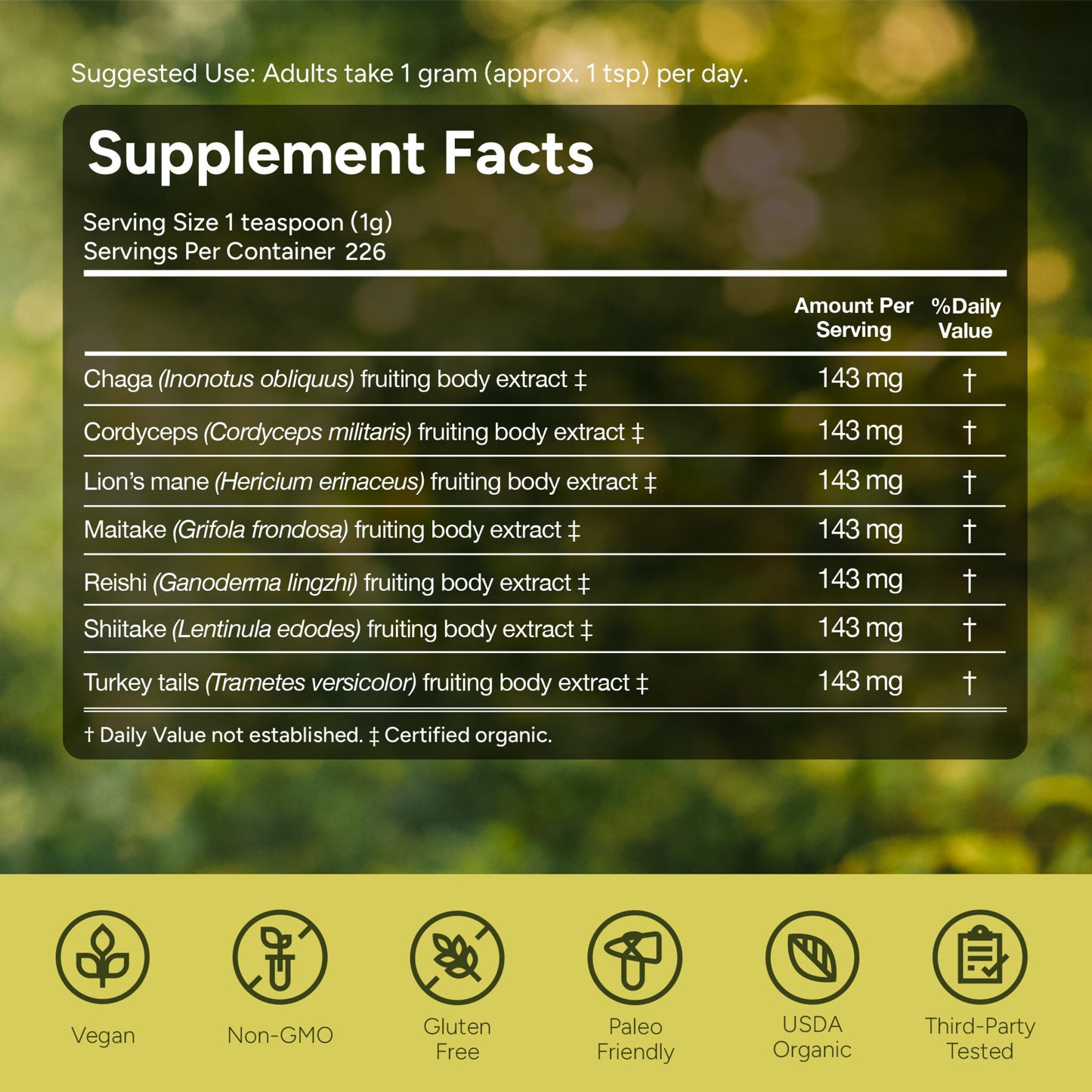
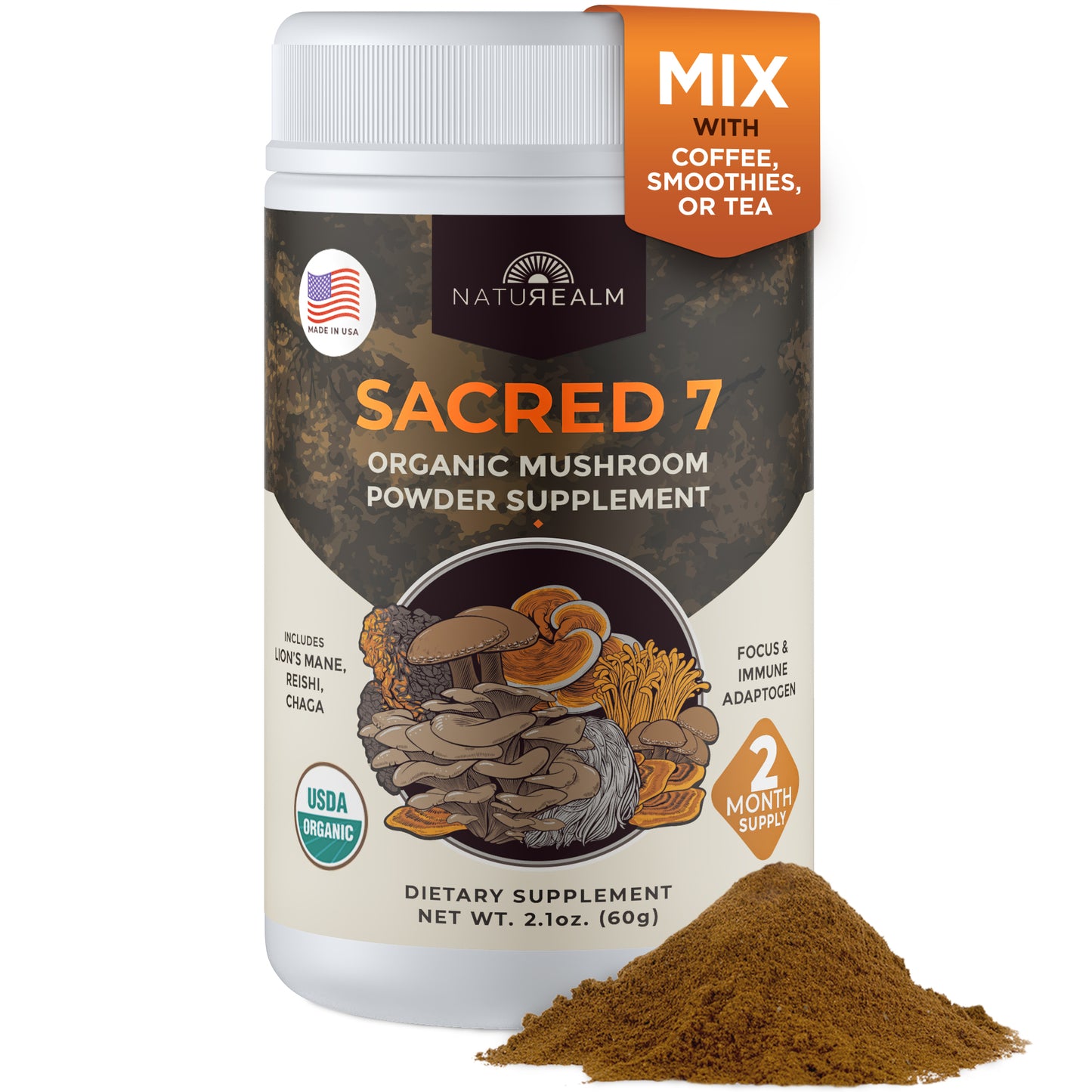
The simplest routine is one serving of a blend at the same time each day. Sacred 7 Mushroom Extract Powder is available directly from Naturealm.
Each level teaspoon is 1,000mg of Lion's Mane, Cordyceps militaris, Reishi, Chaga, Turkey Tail, Shiitake, and Maitake in equal parts: 100% fruiting body, hot water extracted at 215°F, and USDA Certified Organic. Stir it into your morning coffee and you've covered focus, energy, and immune support in one step. Prefer capsules? Three Sacred 7 Capsules equal one teaspoon.
Should You Take Mushroom Supplements With Food or on an Empty Stomach?
Take them with food unless your label says otherwise. It's easier on digestion, and there's no evidence an empty stomach works better.
The most common side effects of mushroom supplements are mild stomach upset and loose stools, and food helps. No study has shown that beta-glucans or triterpenes absorb better on an empty stomach. A few format notes:
- Mushroom powder: stir into coffee, tea, a smoothie, or oatmeal. See how to use mushroom powder.
- Capsules: take with breakfast or another meal.
- Tinctures: add droppers to a drink or take them directly. Ours are dual extracted in organic cane alcohol and hot water. Read Mushroom Tinctures: How to Choose & Use the Best for You.
For a side-by-side look at formats, see mushroom powders vs. capsules.
Can You Take Mushroom Supplements With Coffee?
Yes. Coffee is the most popular way to take them, and Lion's Mane, Cordyceps, and Chaga pair well with your morning caffeine.
Mushroom coffee products blend the two for you, but they often contain only a small amount of mushroom. Adding a measured serving of mushroom powder to your own coffee gives you more control over the dosage. Save Reishi for an evening tea instead of your coffee, and if caffeine already keeps you up, skip the afternoon cup. More in Lion's Mane and coffee.

How Long Do Mushroom Supplements Take to Work?
Most people notice changes after 2 to 4 weeks of daily use, and the human studies that showed results ran 3 to 16 weeks.

A single dose of Lion's Mane changed one focus test in the Docherty study, but most results show up with time: 3 weeks for the Cordyceps blend, 16 weeks for Lion's Mane in older adults. In the Mori trial, the benefits faded within weeks of stopping. Pick a time, tie it to a daily habit, and give it a month before you judge.
Can You Take More Than One Mushroom at Once?
Yes. Many people take two or three together, and a blend covers several species in one serving.
Lion's Mane and Cordyceps pair well in the morning, and Reishi fits the evening. If you'd rather not track separate products, a mushroom blend like Sacred 7 does it in one step. See how to stack different mushrooms for combinations.
Check with your provider first if you're pregnant or breastfeeding, take blood thinners, blood pressure or diabetes medication, or immune-suppressing drugs, or have surgery coming up. Our guide on how to talk to your doctor about mushroom supplements covers what to ask.
Frequently Asked Questions
Is It Better to Take Mushroom Supplements in the Morning or at Night?
For most people, the morning. It's the easiest time to build a daily habit, and Lion's Mane, Cordyceps, and blends like Sacred 7 are studied for focus and energy, which you want during the day. Reishi is the exception: it's studied for calm and sleep, so it fits the evening. If you take several, split them: energizing mushrooms in the morning, Reishi at night.
What Is the Best Time to Take Lion's Mane?
Morning or early afternoon, often in coffee. Lion's Mane is studied for focus, memory, and cognitive function, so a morning dose lines it up with your workday. It isn't a stimulant, so an afternoon dose won't keep you up the way caffeine can.
When Should You Take Reishi?
In the evening, about an hour before bed, often in a caffeine-free tea. Reishi is studied for calm, stress, and sleep. Check with your provider first if you take blood thinners or blood pressure medication.
When Should You Take Cordyceps?
In the morning or 30 to 60 minutes before exercise. Cordyceps is studied for energy and endurance; the trials tested daily use, so consistency matters more than the exact pre-workout window.
Will Lion's Mane or Cordyceps Keep You Up at Night?
They aren't stimulants, so they don't work like caffeine. The morning suggestion comes from what each is studied for: Lion's Mane for focus and Cordyceps for energy, which most people want during the day. If you take them in coffee, the caffeine matters more for sleep, so skip the afternoon cup if it keeps you up.
What Should You Do If You Miss a Dose?
Take your next serving at your usual time and carry on. The benefits in studies come from consistent use over weeks, not from any single well-timed dose, so one missed day matters far less than the habit. Tying your serving to something you already do every morning, like coffee, makes misses less likely.
Can You Split Mushrooms Between Morning and Evening?
Yes, and many routines do. A simple split is Lion's Mane or Sacred 7 in your morning coffee, Cordyceps before a workout, and two droppers of Reishi tincture in a caffeine-free tea at night. If you'd rather keep one time slot, Sacred 7 covers all seven mushrooms, Cordyceps included, in one serving.
How Much Mushroom Powder Should You Take Each Day?
Follow the serving on your label. For Sacred 7, that's one level teaspoon of powder or 3 capsules, which holds 1,000mg of all seven mushrooms. For Reishi tincture, the evening routine above uses two droppers in tea. See how much mushroom powder to take.
Shop Sacred 7 Powder →Find your mushroom match →
References
- Docherty S, Doughty FL, Smith EF. "The Acute and Chronic Effects of Lion's Mane Mushroom Supplementation on Cognitive Function, Stress and Mood in Young Adults: A Double-Blind, Parallel Groups, Pilot Study." Nutrients, 2023. doi:10.3390/nu15224842
- Mori K, et al. "Improving Effects of the Mushroom Yamabushitake (Hericium erinaceus) on Mild Cognitive Impairment: A Double-Blind Placebo-Controlled Clinical Trial." Phytotherapy Research, 2009. doi:10.1002/ptr.2634
- Hirsch KR, et al. "Chronic Supplementation of a Mushroom Blend on Oxygen Kinetics, Peak Power, and Time to Exhaustion." Journal of the International Society of Sports Nutrition, 2015 (conference abstract). doi:10.1186/1550-2783-12-S1-P45
- Cui XY, et al. "Extract of Ganoderma lucidum Prolongs Sleep Time in Rats." 2012.
- Yao C, et al. "Ganoderma lucidum Promotes Sleep Through a Gut Microbiota-Dependent and Serotonin-Involved Pathway in Mice." Scientific Reports, 2021. doi:10.1038/s41598-021-92913-6
- Saleh MH, Rashedi I, Keating A. "Immunomodulatory Properties of Coriolus versicolor: The Role of Polysaccharopeptide." Frontiers in Immunology, 2017. doi:10.3389/fimmu.2017.01087
These statements have not been evaluated by the Food and Drug Administration. This product is not intended to diagnose, treat, cure, or prevent any disease.