

Why Mushroom Blends Work Better Than Single Ingredients (The Science of Synergy)
The supplement industry loves a hero ingredient. One compound, one mechanism, one benefit claim. It's clean to market and easy to explain. But fungi don't work that way — and the research increasingly suggests that when it comes to mushrooms, the combination is the point.
This is what synergy actually means in the context of functional mushrooms: not just "more benefits," but mechanisms that reinforce, amplify, and sometimes depend on each other. Here's what the science shows.
The Immune System Is Not One Thing
Most people think of immune support as a single dial you turn up or down. The reality is more like a network: innate immunity, adaptive immunity, inflammatory response, antioxidant defense, gut-mediated immune signaling. Mushrooms work across multiple nodes of that network simultaneously — and different species target different nodes.
Turkey tail (Trametes versicolor) contains PSK and PSP, polysaccharides documented to modulate adaptive immune response — specifically the calibration of T-cell activity. Chaga (Inonotus obliquus), wild-harvested from birch trees, brings extraordinary antioxidant capacity via betulinic acid, which works at the cellular defense layer. Reishi (Ganoderma lucidum) contributes triterpenes (ganoderic acids) that influence cortisol and inflammatory signaling at the hormonal level.
None of these mechanisms duplicate each other. They cover different ground in the same system. Taking all three together means you're not getting "three times the immunity" — you're getting immune support with actual breadth. Research on multi-species immune blends supports this: combining Turkey Tail, Maitake, and Reishi shows superior immune modulation compared to single-mushroom products (Lindequist, 2024).
Beta-Glucans Stack, but They're Not All the Same
Beta-glucans are the primary immune-active polysaccharides in mushrooms — the compounds most studied, most documented, and most responsible for why mushroom supplements do what they do. Every mushroom in a quality blend contains them.
But beta-glucans from different species have different molecular structures: different chain lengths, branching patterns, and receptor binding profiles. This structural variation matters. A 2024 NIH-published study documented enhanced immune activation when multiple beta-glucan sources were combined — with measurable improvements in immune cell response that single-source formulations did not produce (Jensen et al., 2024).
In plain terms: the beta-glucans in lion's mane are not identical to the beta-glucans in shiitake, which are not identical to those in turkey tail. A blend delivers structural diversity that a single ingredient can't.
Cognitive + Stress + Sleep: A Compounding Loop
Lion's mane (Hericium erinaceus) stimulates nerve growth factor (NGF), which supports neuron maintenance and growth. This is its flagship mechanism, covered extensively in the research literature (Lindequist, 2024). But the brain doesn't operate in isolation from the body's stress load.
Elevated cortisol — the chronic, low-grade kind most people carry — actively suppresses NGF production and impairs hippocampal neurogenesis. In other words: if you're chronically stressed, the cognitive benefits of lion's mane are working against a headwind.
This is where reishi's adaptogenic properties become directly relevant to lion's mane's efficacy. Reishi modulates cortisol and supports the parasympathetic (rest/repair) nervous system. Lower baseline stress means a more receptive environment for the neurological work lion's mane is doing.
Layer in reishi's sleep support — deeper, more restorative sleep is where the brain does the majority of its consolidation and repair — and you have a feedback loop: better stress regulation leads to better sleep, better sleep leads to better cognitive function, and lion's mane has a more favorable environment to do its work.
No single ingredient creates this loop. The combination does. This is precisely what synergy means in the context of functional mushrooms: taking at least two different species to enjoy benefits that neither produces alone (Harmonic Arts, 2022).
Gut Health Is the Hidden Multiplier
Turkey tail and maitake (Grifola frondosa) are both prebiotic mushrooms — they feed and support beneficial gut bacteria rather than simply acting as direct supplements. This is increasingly important context because approximately 70% of immune cells are located in the gut, and the gut-brain axis means microbiome health directly influences mood, cognition, and stress response.
The NIH's review of medicinal mushrooms as multicomponent mixtures notes that beta-glucans from mushrooms influence cytokine levels — the signaling molecules that regulate immune response — with downstream effects on gut and systemic inflammation (Lindequist, 2024). Maitake's beta-glucan D-fraction has shown similar prebiotic and metabolic activity in subsequent research.
When gut health improves, the downstream effects touch everything else: immune calibration, neurological health via the vagus nerve, metabolic regulation. Mushrooms that support the microbiome aren't just gut products. They're systemic.
Energy Without Stimulants: The Metabolic Layer
Cordyceps (Cordyceps militaris) and maitake work on energy from different angles. Cordyceps acts on ATP synthesis and oxygen utilization — the cellular machinery of physical energy output. Maitake's beta-glucan D-fraction improves insulin sensitivity, which affects how efficiently cells use glucose.
Neither is a stimulant. Both improve the efficiency of energy systems that are already there. Together, they address energy at both the aerobic and metabolic levels — which is why people who use blends containing both often report more sustained energy without the spike-and-crash of caffeine or adrenal stimulation (Eversio Wellness, 2025).
Shiitake (Lentinula edodes) adds a cardiovascular layer: eritadenine has documented LDL-lowering effects, and better cardiovascular function means better oxygen delivery — which feeds back into the energy system cordyceps is optimizing. NIH-published research has also documented shiitake's high free radical scavenging capacity and its role in inhibiting aberrant cell proliferation (Lindequist, 2024).
The Case Against Fragmentation
Single-ingredient supplements appeal because they're easy to attribute. "I take lion's mane for focus." Clean, legible, controllable. But the body doesn't work in silos, and neither do fungi.
The mycelial network is the oldest communication system on earth — a network that evolved to support entire ecosystems through chemical signaling, resource sharing, and symbiotic exchange. It shouldn't be surprising that the fruiting bodies that emerge from that network carry their own interdependencies, and that those interdependencies translate into compounding benefit when consumed together.
This isn't a marketing argument. It's structural. Unlike single-mushroom supplements, well-formulated blends address multiple bodily systems simultaneously — supporting immunity while managing stress at the same time (Eversio Wellness, 2025). The mechanisms are different, the targets are different, and the systems they support are interconnected.
A Note on Quality in Blends
Not all blends are equal, and quality failures are common in this category. The two most important things to verify:
Fruiting bodies only. Mycelium-on-grain products dilute the bioactive content significantly. A blend that uses mycelium is a blend where you're mostly buying grain starch. The beta-glucan content will be a fraction of what's on the label (Harmonic Arts, 2022).
Dual extraction. Beta-glucans are water-soluble — hot water extraction captures them. Triterpenes (like the ganoderic acids in reishi) are alcohol-soluble — alcohol extraction captures those. A blend that uses only one extraction method is leaving compounds behind.
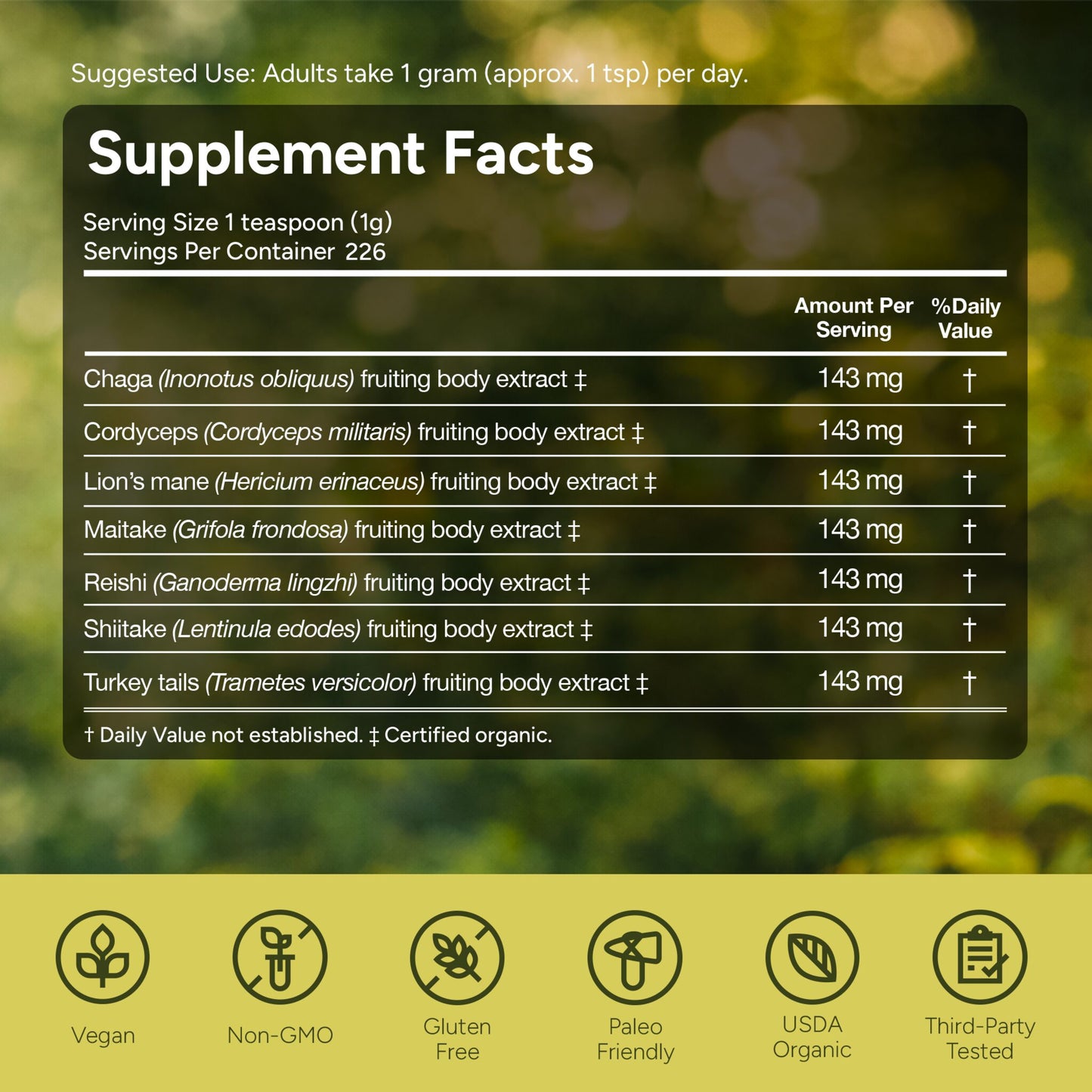
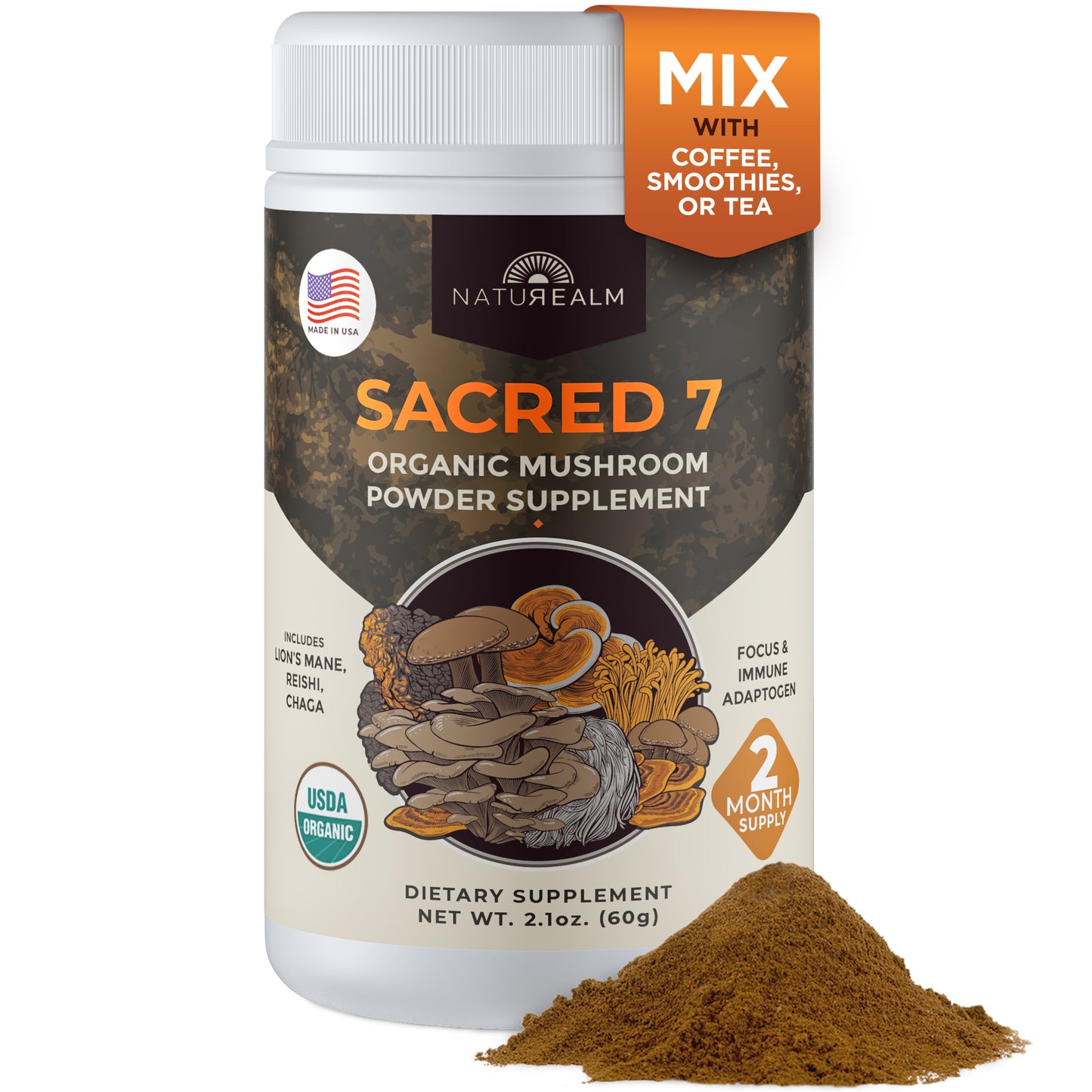
Sacred 7 uses 100% USDA organic fruiting bodies, dual-extracted, with no fillers, grains, or mycelium. That's the baseline that makes the synergy real.
Explore Sacred 7
References
Eversio Wellness. (2025, June 30). Mushroom blends 101: An essential guide to benefits and synergy. https://www.eversiowellness.com/blogs/wellness/mushroom-blends-101
Harmonic Arts. (2022, October 3). Shroom school: How to cultivate mushroom synergy. https://harmonicarts.ca/blogs/how-to-cultivate-mushroom-synergy
Jensen, G. S., Drapeau, C., Lenninger, M., & Benson, K. F. (2024). Effects of a β-glucan-rich blend of medicinal mushrooms and bovine colostrum peptides on immune activation. PubMed Central, National Institutes of Health. https://pmc.ncbi.nlm.nih.gov/articles/PMC11207084/
Lindequist, U. (2024). Medicinal mushrooms as multicomponent mixtures. PubMed Central, National Institutes of Health. https://pmc.ncbi.nlm.nih.gov/articles/PMC10890338/