

Treating HPV With Turkey Tail and Other Medicinal Mushrooms
The use of medicinal mushrooms dates back to ancient times, and in the last half-century, science has only begun to catch up with what folk medicine has long understood. As modern research deepens, we're seeing a growing body of clinical evidence for mushrooms in the context of viral infections, immune regulation, and cancer support. One of the most compelling emerging applications: the use of medicinal mushrooms — particularly Turkey Tail mushrooms and Reishi mushroom — as a complementary approach for people managing HPV.
A Brief History: Medicinal Mushrooms and Modern Medicine
In the 1980s, Dr. Ikekawa, a researcher at Japan's National Cancer Institute, noticed that cancer death rates were significantly lower in families who grew Enoki mushrooms. His subsequent long-term study of nearly 200,000 people in Nagano Prefecture sparked a wave of scientific interest in therapeutic mushroom use across Japan, China, and eventually the West.
What researchers found was that medicinal mushrooms are, in a sense, miniature pharmacies. They produce a complex range of bioactive compounds — antiviral and anti-inflammatory triterpenes, steroids, and high concentrations of beta-glucans (complex carbohydrates also called polysaccharides) known for their broad-spectrum health effects. Crucially, medicinal mushrooms are adaptogenic: rather than simply stimulating the immune system, they modulate it — nudging it toward whatever response the individual's body most needs. This immune modulation is central to their relevance in HPV management (1).
What Is HPV?
Human papillomavirus (HPV) is the most common sexually transmitted viral infection globally. In 2018, 43 million people received a diagnosis. HPV spreads through sexual contact or skin-to-skin contact, and risk factors include multiple sexual partners, compromised immunity, and broken skin. Most cases manifest as warts on the skin or mucous membranes. In a smaller percentage — particularly with high-risk HPV infection strains like HPV16 — persistent infection can drive chronic inflammation and, over time, progress to cervical cancer, cervical dysplasia, or other HPV-associated cancers (2).
For women, diagnosis typically comes via pap smear and cervical cell sampling. No equivalent diagnostic test currently exists for men. Persistent HPV infections can last from a few years to a lifetime, and conventional medicine offers no direct antiviral cure — only surveillance, treatment of symptoms, and HPV vaccination for prevention.
HPV vaccination (Gardasil) is CDC-recommended for girls and boys starting around age 11–12, before sexual activity begins. It's one of the most effective preventive tools available, particularly against HPV16 and other high-risk strains associated with cervical cancer.
For those already living with an HPV diagnosis — particularly HPV positive women managing persistent HPV infections — the research on medicinal mushrooms offers something conventional medicine currently doesn't: a targeted, evidence-backed approach to supporting HPV clearance through immune function.
Turkey Tail Mushrooms and HPV
Turkey Tail mushrooms (Trametes versicolor, also known as Coriolus versicolor or yun zhi in Traditional Chinese Medicine) have been used for millennia to promote general health, strength, and longevity. For the last three decades, Japanese and Chinese physicians have used approved Turkey Tail products — specifically Polysaccharide-K (PSK, marketed as Krestin) and Polysaccharide Peptide (PSP) — alongside conventional cancer treatments including radiation and chemotherapy (3).
The mechanism is one of precise immune modulation: Turkey Tail's polysaccharopeptides help activate white blood cells and dendritic cells — the immune system's frontline detectors — to identify and target infected or abnormal cells without disrupting healthy tissue. PSP, in particular, has been shown to increase white blood cell populations and enhance the body's innate immune response to viral infections.
Applied to HPV: a preliminary clinical trial found that a combination of Turkey Tail and Reishi mushroom led to HPV clearance in 88% of participants with oral HPV — in as little as two months (4). While larger-scale trials are still needed, this is a meaningful signal for anyone exploring natural approaches to HPV management.
Turkey Tail's beta-glucans and β-glucan fractions also contribute to gut microbiome health via prebiotic activity — increasing beneficial bacteria while suppressing harmful strains. This matters for HPV specifically because a healthy gut microbiome is increasingly linked to stronger systemic immune response, including faster clearance of persistent HPV infections (3).
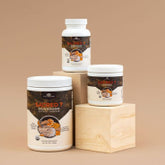
Turkey Tail is one of seven species in Sacred 7 — 100% fruiting body, hot water extracted, USDA Organic.
Shop Sacred 7 Powder Shop Sacred 7 CapsulesOther Medicinal Mushrooms Used to Support HPV Clearance
Stacking mushroom supplements can significantly enhance immune support for HPV management. The most well-studied combinations layer Turkey Tail's PSK and PSP activity with the distinct bioactive compounds of complementary species.
Reishi Mushroom (Ganoderma lucidum)
In Traditional Chinese Medicine, Reishi mushroom (Ganoderma lucidum) is the Mushroom of Immortality — and its compound profile backs the title. Reishi's triterpenes, beta-glucans, and polysaccharides give it documented antiviral, anti-cancer, antibacterial, and anti-inflammatory properties. Its anti-cancer properties operate partly through activation of dendritic cells and natural killer cells — the same immune pathways relevant to clearing high-risk HPV infection.
The clinical trial referenced above combined Turkey Tail and Reishi mushroom specifically for oral HPV — with 88% of participants testing negative after two months (4). Beginning with 1,000–2,000mg daily of each is the general starting point, though dosage guidance from a healthcare provider is recommended.
Shiitake Mushrooms (Lentinula edodes)
Shiitake mushrooms are packed with antioxidants, beta-glucans, and anti-inflammatory polysaccharides that help balance immune system response. The most clinically relevant compound for HPV is AHCC (Active Hexose Correlated Compound) — a standardized Shiitake mushroom extract produced through enzymatic decomposition of the mushroom's alpha-glucan fraction.
A significant clinical trial found that AHCC supplementation produced HPV clearance in nearly 64% of HPV positive women with persistent HPV infections over a six-month period. Critically, the majority of those women continued to test negative six months after stopping supplementation — suggesting durable HPV clearance, not just temporary suppression (5). The protocol: 3g of AHCC daily on an empty stomach, in divided doses.
This is one of the stronger clinical signals for a single medicinal mushroom compound in the context of HPV specifically — and it's driven by the same class of bioactive compounds (β-glucan fractions, polysaccharides) found across the broader family of functional mushrooms.
Additional Species Worth Considering
Several other medicinal mushrooms have documented antiviral activity and immune modulation properties relevant to HPV immune support:
- Chaga — potent antioxidant and antiviral; betulinic acid content studied for antiviral activity against multiple virus strains
- Cordyceps — immune modulation and energy support; polysaccharides shown to activate macrophages and dendritic cells
- Maitake — D-fraction beta-glucans with documented immune-activating effects; studied for both anti-cancer and immune support applications
- Agaricus blazei — beta-glucan-rich species with antiviral activity and documented immune modulation in preliminary research
Taken together, these species represent a complementary stack — each contributing distinct bioactive compounds that reinforce different aspects of immune response. Here's why a well-formulated mushroom blend outperforms single-species supplementation for most people.
What to Look for When Choosing a Mushroom Supplement for HPV Support
Not all mushroom supplements are created equal — and for something as specific as HPV immune support, the quality of what you take matters significantly. Here's what to look for:
- Fruiting body sourcing: The fruiting body is where the highest concentrations of beta-glucans, polysaccharopeptides, and bioactive compounds are found. Mycelium-on-grain products are typically 60–70% grain filler — not mushroom.
- Dual extraction: For species like Reishi, both hot water extraction (for water-soluble polysaccharides and beta-glucans) and alcohol extraction (for fat-soluble triterpenes) are needed to capture the full compound profile. Single water extraction misses the triterpenes entirely.
- Beta-glucan content listed: A reputable brand will disclose beta-glucan percentage on the label. High β-glucan, low starch = quality extract. High starch = grain filler.
- Third-party testing: Certificates of Analysis (COA) from independent labs confirm potency and absence of contaminants.
- For AHCC specifically: Look for standardized Shiitake mushroom extract with confirmed AHCC content — not just generic Shiitake powder.
The quality gap in the mushroom supplement category is significant — doing the label work before you buy is not optional when you're using mushrooms for a specific health purpose.
Sacred 7 includes Turkey Tail, Reishi, and five other species — all 100% fruiting body, hot water extracted, USDA Organic. Subscribe & Save for daily immune support.
Shop Sacred 7 Powder Shop Sacred 7 CapsulesThe Bottom Line
For people managing HPV — particularly HPV positive women with persistent HPV infections, cervical dysplasia, or high-risk HPV infection strains like HPV16 — the evidence for medicinal mushrooms as immune support is more substantive than most people realize. Turkey Tail mushrooms (Trametes versicolor) with their PSK, PSP, and polysaccharopeptide content. Reishi mushroom (Ganoderma lucidum) with its triterpenes and anti-cancer properties. Shiitake mushrooms and AHCC with their documented HPV clearance results in clinical trials.
None of this replaces routine pap smear screening, medical monitoring, or HPV vaccination for those who haven't yet been infected. What it does offer is a complementary, evidence-backed approach to immune modulation that addresses the root mechanism — a dysregulated immune system that can't clear the virus on its own.
The medicinal mushrooms with the strongest signal here work by activating white blood cells, dendritic cells, and natural killer cells — the same immune actors responsible for identifying and clearing viral infections. That's not folk wisdom anymore. That's clinical research.
References
- Khan, Tabassum, et al. "Polysaccharides as Potential Anticancer Agents." Carbohydrate Polymers, 2019. https://doi.org/10.1016/j.carbpol.2019.01.064
- Fernandez, Jose Verissimo, et al. "Link between Chronic Inflammation and Human Papillomavirus-Induced Carcinogenesis." Oncology Letters, 2015. https://doi.org/10.3892/ol.2015.2884
- Saleh, Mohammad H., et al. "Immunomodulatory Properties of Coriolus Versicolor." Frontiers in Immunology, 2017. https://doi.org/10.3389/fimmu.2017.01087
- Donatini, Bruno. "Control of Oral Human Papillomavirus (HPV) by Medicinal Mushrooms, Trametes Versicolor and Ganoderma Lucidum." International Journal of Medicinal Mushrooms, 2014. https://doi.org/10.1615/intjmedmushrooms.v16.i5.80
- Smith, Judith A., et al. "AHCC Supplementation to Support Immune Function to Clear Persistent Human Papillomavirus Infections." Frontiers in Oncology, 2022. https://doi.org/10.3389/fonc.2022.881902