


How Mushrooms, and Sacred 7, Can Help Perimenopause Symptoms
Somewhere in your late 30s or 40s, the body stops running on the same rules. Sleep gets harder even when you're doing everything right. Focus fragments. You wake up at 2 a.m. hot and wired. Moods shift and mood swings occur in ways that feel neurological, not emotional, and honestly, they are. Energy stops tracking with how much rest you got. Weight redistributes somewhere you didn't sign off on.
This is perimenopause. Not a malfunction. A hormonal restructuring that hits multiple systems at once, because estrogen and progesterone don't just regulate your cycle. They influence cortisol response, gut microbiome composition, immune function, neurotransmitter production, and cognitive function. When they fluctuate and eventually decline, the downstream effects are wide.
That's why a single-symptom supplement almost never works for the complex range of menopausal symptoms experienced here. It's not one problem.
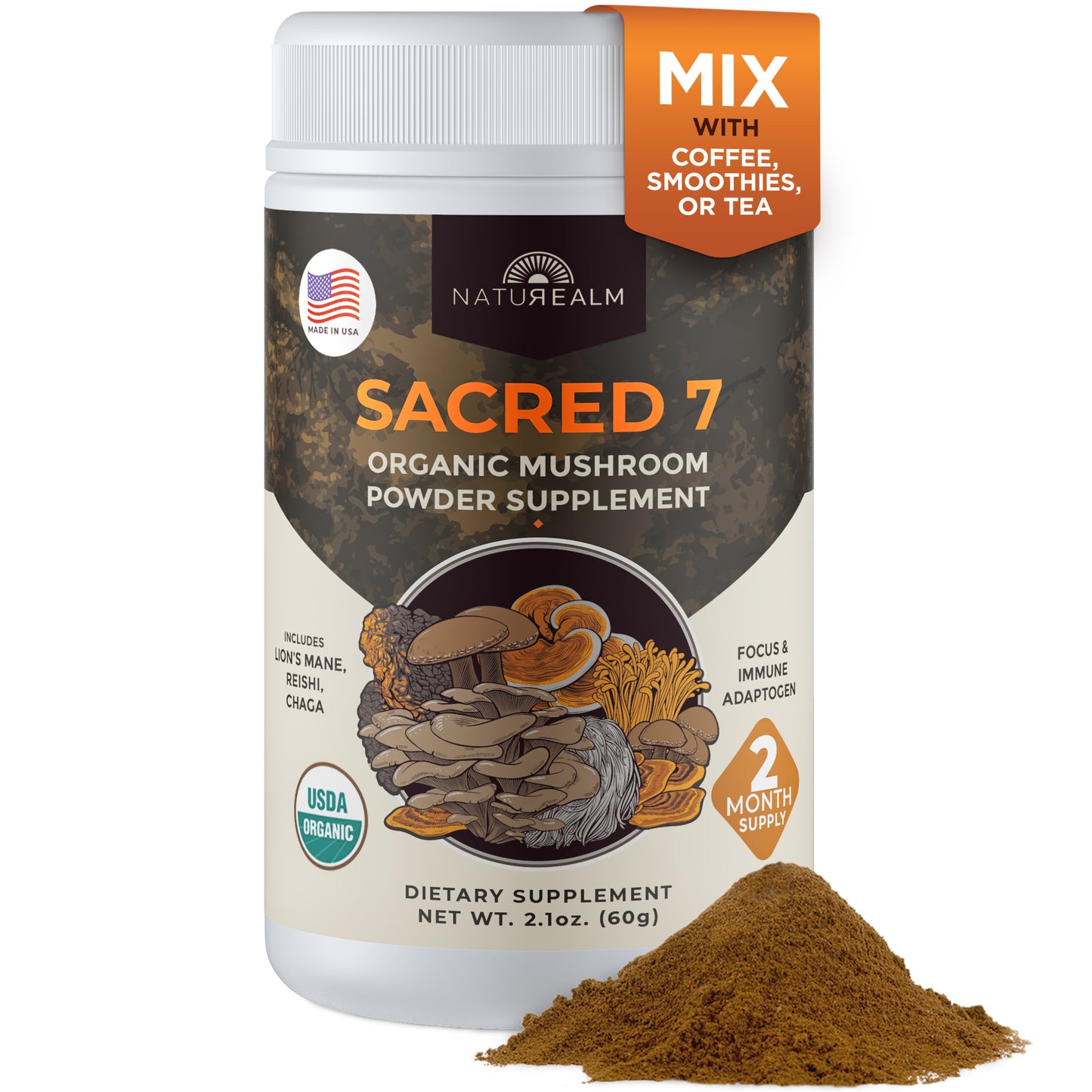
Sacred 7 contains seven functional mushrooms, each with documented mechanisms that map directly to what the body is navigating during the menopausal transition. Here's what each one actually does, and why the research matters.
Why Adaptogenic Mushrooms Work Differently Here
Adaptogenic compounds don't suppress symptoms or flood a receptor. They help the body regulate its own stress response systems: the HPA axis (cortisol), immune signaling, and the gut-brain axis. During perimenopause, when the endocrine system is actively recalibrating, that kind of systemic support is more useful than targeted suppression.
Functional mushrooms are also rich in polysaccharides, specifically beta-glucans, which are the primary bioactive compounds responsible for immune modulation. They contain triterpenes, ergosterol (a vitamin D precursor), and in some species, compounds that interact directly with neurological receptors.
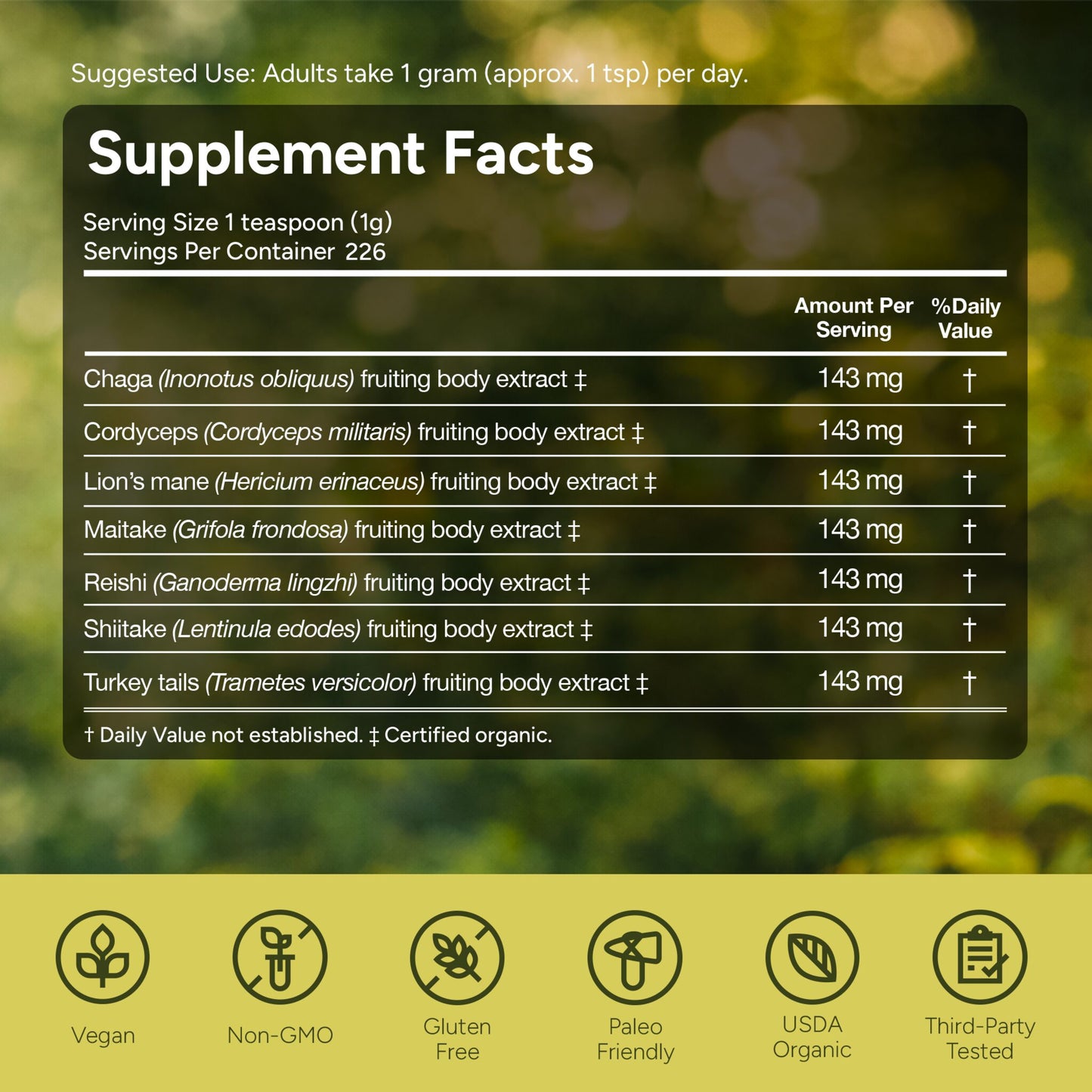
Sacred 7 uses 100% fruiting body material for all seven mushrooms. No mycelium on grain or starch filler. That distinction matters because fruiting bodies are where beta-glucans concentrate. Mycelium-on-grain products often carry far less, with up to half the powder being grain starch. Same label, completely different product.
The 7 Mushrooms, and What They Do
Lion's Mane (Hericium erinaceus): Brain Fog, Mood, Cognitive Function
The lion's mane mushroom is the most studied functional mushroom for neurological health, and its connection to perimenopause is direct.
Estrogen supports neuroplasticity, mood regulation, and the production of serotonin and dopamine. As it declines, cognitive function shifts. Word retrieval slows. Focus breaks. Mood changes arrive that feel neurological because they are.
Lion's mane contains hericenones and erinacines, bioactive compounds that stimulate nerve growth factor (NGF) production. NGF is a protein essential for the growth, maintenance, and survival of neurons. Low NGF is linked to cognitive decline and depression.
In a clinical trial, four weeks of lion's mane intake significantly reduced depression and anxiety compared to placebo, with researchers noting its relevance to mood changes during hormonal fluctuation. (PubMed: 20834180) Separate research examined lion's mane's effect in ovariectomized rats, a model of surgical menopause, and found significant improvement in depressive-like behavior, pointing to the mushroom's effects on NGF and neurological signaling being specifically relevant to estrogen reduction. (DOI: 10.1248/bpb.b22-00151)
Lion's mane also contains phytoestrogen compounds that may interact with estrogen receptors in the brain, contributing to mood stabilization. This is still under active research, but the clinical evidence for brain health, mood, and cognitive function during the menopausal transition is the strongest of any functional mushroom.
Targets: Brain Fog, Mood Instability, Focus, Word Retrieval.
Reishi (Ganoderma lingzhi): Cortisol, Sleep, Stress
Reishi has been used in traditional Chinese medicine for over 2,000 years. During perimenopause, its primary job is cortisol regulation and sleep quality.
When estrogen and progesterone decline, the HPA axis becomes less buffered. Stress hits harder, cortisol spikes more easily, and the body takes longer to return to baseline. Elevated cortisol at night is a primary driver of sleep disruption and night sweats, keeping the nervous system in low-grade activation when it should be winding down.
Reishi's triterpenes, concentrated in the fruiting body, have demonstrated anti-inflammatory and cortisol-modulating effects. As an adaptogen, it supports the adrenal response to stress without sedating or stimulating.
Research also connects reishi to improvements in total sleep time and non-rapid-eye-movement sleep, which is the restorative phase most disrupted during the menopausal transition.
Targets: Night Sweats, Sleep Quality, Stress-Driven Hot Flashes, Cortisol Dysregulation.
Cordyceps (Cordyceps militaris): Energy, Mitochondria, Libido
Fatigue during perimenopause isn't regular tiredness. It's cellular. The decline in estrogen and progesterone disrupts mitochondrial efficiency, reducing ATP production, your body's primary energy currency. Sleep stops restoring energy the way it used to.
Cordyceps supports mitochondrial function and increases cellular oxygen utilization. It also has documented effects on adrenal hormone balance, which matters because the adrenal glands take over some estrogen and androgen production as ovarian hormone output declines.
Cordyceps has also been studied for testosterone production in Leydig cells. Testosterone plays a role in women's energy levels, bone density, and libido, all commonly affected during the menopausal transition.
This is not a stimulant. It raises energy through mitochondrial support, not adrenal spike. That difference matters when cortisol is already running high.
Targets: Fatigue, Exercise Tolerance, Libido, Energy Levels That Don't Respond to Sleep.
Turkey Tail (Trametes versicolor): Immune System, Gut Microbiome
The gut microbiome contains a community of bacteria called the estrobolome, which regulates how estrogen is metabolized and recirculated. Disruptions to the gut microbiome during the menopausal transition impair this regulation, contributing to hormonal fluctuations and inflammation.
Turkey tail's polysaccharides, PSK and PSP, are among the most researched immune-modulating compounds in any functional mushroom. A randomized clinical trial found measurable positive changes in gut microbiome composition following polysaccharopeptide from Trametes versicolor, with implications for immune system balance. (PubMed: 25006989)
During perimenopause, when immune dysregulation and gut disruption are both common, turkey tail's contribution to the gut-immune axis is significant, even if it's not always the one making headlines.
Targets: Immune Resilience, Gut Microbiome Support, Estrogen Metabolism, Inflammation.
Chaga (Inonotus obliquus): Antioxidants, Inflammation, Blood Sugar
Oxidative stress increases during and after the menopausal transition. Estrogen has antioxidant properties, and its decline leaves cells more vulnerable to free radical damage, contributing to inflammation, accelerated cellular aging, and the skin changes many women notice post-menopause.
Chaga has among the highest antioxidant content of any functional mushroom or natural food source, driven by its melanin pigments, polyphenols, and superoxide dismutase (SOD) activity. Its anti-inflammatory profile is broad-spectrum: it modulates cytokine production, reduces oxidative damage markers, and supports immune system balance.
Chaga also supports healthy blood sugar regulation. Insulin sensitivity decreases during the menopausal transition, and that metabolic shift is a significant driver of weight gain and energy volatility. Research on the neuronal health implications of antioxidants from medicinal mushrooms, including chaga, has been reviewed in PMC research examining how functional mushrooms support long-term brain health. (PMC: 3924905)
Targets: Antioxidant Defense, Blood Sugar Regulation, Inflammation, Weight Management.
Maitake (Grifola frondosa): Metabolic Health, Blood Sugar, Hormonal Balance
Maitake is the underrated member of Sacred 7 for perimenopause, and it deserves more attention than it gets.
During the menopausal transition, insulin sensitivity declines. Weight gain, specifically visceral fat, becomes more common, not because of caloric intake but because of how declining estrogen shifts fat distribution and alters glucose processing. Visceral fat also produces estrogen, which can create hormonal imbalance even as ovarian estrogen declines.
Maitake contains beta-glucans with documented effects on blood sugar regulation and insulin sensitivity. It also contains ergothioneine, increasingly studied as a "longevity vitamin" and a powerful antioxidant that accumulates specifically in tissues under oxidative stress.
For the metabolic disruption that accompanies perimenopause, maitake addresses one of the root causes of weight gain, energy volatility, and hormonal fluctuations that other mushrooms in the blend don't reach as directly.
Targets: Blood Sugar Regulation, Metabolic Health, Weight Management, Hormonal Balance.
Shiitake (Lentinula edodes): Immune Function, Gut Health, Anti-Inflammatory
Shiitake is familiar from the kitchen, but as an extracted supplement it has documented immune-modulating and anti-inflammatory effects that reinforce the rest of the blend.
Its primary bioactive compound is lentinan, a beta-glucan with well-established immune system modulating properties. Shiitake is also one of the richest sources of ergothioneine and one of the few foods with meaningful vitamin D content when UV-exposed, a nutrient commonly deficient in post-menopausal women.
Paired with turkey tail in Sacred 7, shiitake extends the gut-immune axis support, contributing prebiotic fiber and polysaccharides that feed the gut microbiome and help keep the immune response balanced.
Targets: Immune Resilience, Anti-Inflammatory Support, Gut Health.
Why the Blend Outperforms Singles
Each of these mushrooms does something real on its own. The reason Sacred 7 works specifically well for the menopausal transition is that the mechanisms compound.
Cortisol dysregulation (reishi) worsens sleep, which worsens brain fog (lion's mane). Poor gut health (turkey tail, shiitake) impairs estrogen metabolism, which worsens hormonal fluctuations. Oxidative stress (chaga) accelerates inflammation that disrupts immune function and mood. Metabolic disruption (maitake) destabilizes blood sugar, which spikes cortisol, which loops back to sleep and mood.
This isn't seven separate problems. It's one interconnected system under stress, and a blend that addresses multiple entry points simultaneously is more effective than stacking single-mushroom supplements and hoping for the right dose and timing. (PMC: 3924905)
What to Expect: A Realistic Timeline
Functional mushrooms work at the systems level, which means the timeline is longer than a stimulant, but the effects are more durable.
- Weeks 1 to 2: Sleep quality improvements often show up first, particularly if cortisol-driven wakefulness is a factor. Some people notice steadier energy or slight mood stabilization.
- Weeks 3 to 4: The clinical trial evidence for Hericium erinaceus shows measurable effects on mood and anxiety at four weeks. (PubMed: 20834180) Gut microbiome shifts also begin in this window.
- Weeks 6 to 8: Cognitive function improvements, focus, word retrieval, reduced brain fog, typically become noticeable with consistent daily use. Immune markers often improve by week 8.
- 3+ months: The full picture. Hormonal balance support, metabolic effects, and anti-inflammatory benefits compound. Most long-term Sacred 7 subscribers report that three months looks significantly different from week four.
Consistency is the variable. Sacred 7 is not a "feel it in an hour" supplement. It's infrastructure.
How to Use It
Add one teaspoon (approx. 1g) of Sacred 7 powder to coffee, tea, or a smoothie in the morning. Morning is optimal for lion's mane (NGF support, cognitive function), cordyceps (energy, mitochondrial support), and maitake (blood sugar regulation with your first meal). Capsules are available if you prefer a pre-measured, no-prep option.
On magnesium: many people in perimenopause are also deficient in magnesium, which works synergistically with reishi's adaptogenic effects for sleep quality and cortisol regulation. Sacred 7 doesn't contain magnesium, but if sleep disruption is the primary concern, it's worth discussing with a healthcare professional.
Consult a healthcare professional before adding any supplement to your routine, particularly if you're on hormone replacement therapy, immunosuppressants, or blood-thinning medications.
The Fruiting Body Difference
Fruiting body sourcing isn't a marketing term; it is the hallmark of a high-quality supplement. It's the production decision that determines whether the bioactive compounds above are actually in your supplement at functional levels.
Most mushroom supplements use mycelium grown on grain. The resulting powder can be up to 50% grain starch by weight. That starch shows up in lab tests as alpha-glucans, which have no immune-modulating activity. Beta-glucans (the active form) in mycelium-on-grain products often test far lower than in fruiting bodies, which is where beta-glucans concentrate.
Sacred 7 uses 100% organic fruiting bodies for all seven mushrooms. No mycelium, no grain, no fillers. What you're measuring on the label is what's in the product.
The Bottom Line
Perimenopause isn't a single symptom. It's a systemic shift that touches sleep, cognition, immune function, gut health, metabolism, mood, and energy at the same time. Sacred 7 addresses each of those systems through documented adaptogenic, anti-inflammatory, and neuroprotective mechanisms.
It won't replicate declining estrogen and progesterone. It supports the systems those hormones were regulating. That's what well-being and overall wellness look like during the menopausal transition, not erasing the shift, but building resilience through it.
Subscribe & Save on Sacred 7 and get 15% off every order, delivered on your schedule. Most people find that three months is where the compounding effects become fully apparent.
Shop Sacred 7 Powder → | Shop Sacred 7 Capsules →
References
Nagano M, et al. Reduction of depression and anxiety by 4 weeks Hericium erinaceus intake. Biomedical Research. 2010. PubMed: 20834180
Ryu S, et al. Ameliorating Effect of the Edible Mushroom Hericium erinaceus on Depressive-Like Behavior in Ovariectomized Rats. Biological and Pharmaceutical Bulletin. 2023. DOI: 10.1248/bpb.b22-00151
Lindequist U. Neuronal Health: Can Culinary and Medicinal Mushrooms Help? PMC. PMC: 3924905
Pallav K, et al. Effects of polysaccharopeptide from Trametes versicolor and amoxicillin on the gut microbiome of healthy volunteers: a randomized clinical trial. Gut Microbes. 2014. PubMed: 25006989
These statements have not been evaluated by the Food and Drug Administration. This product is not intended to diagnose, treat, cure, or prevent any disease. Consult a healthcare professional before starting any new supplement, particularly during hormonal transitions or if you are taking prescription medications.