

What Is the Best Mushroom Coffee Alternative?
The best mushroom coffee alternative depends on two things: whether you want caffeine, and whether you want to keep your own coffee. Atlas+, Shroomi, and Rasa are the names that come up most in published reviews. Atlas+ tops two published taste tests, Shroomi is a well-reviewed ground option, and Rasa is the most-cited caffeine-free pick. Most caffeinated alternatives land between 35 and 50mg of caffeine per serving, roughly half a regular cup. A fourth route skips the blend entirely: stir a mushroom extract into the coffee you already drink. Whichever you choose, look for per-species doses, fruiting body extracts, third-party testing, and a stated caffeine number. No human trial has tested a finished mushroom coffee product, and clinical studies use far larger single-mushroom doses than most blends supply.
What Are the Best Mushroom Coffee Alternatives?
The best mushroom coffee alternatives are Atlas+, Shroomi, and Rasa, the three names that come up most in published reviews.
- Taste of Home named Atlas its best beverage of 2025, and its tester noted each serving has only 45mg of caffeine.
- Chowhound ranked eight brands and put the Atlas Coffee Superblend first, with the Atlas Latte Superblend in second.
- Shroomi says it was named Best Mushroom Coffee 2025 by Bon Appétit and Best Mushroom Infused Coffee of 2025 by WIRED.
MUD\WTR sits just outside the category. It's a chai and cacao drink rather than coffee, and one tester found it more of a tea than coffee.
| Product | Format | Caffeine per serving | Recognized by |
|---|---|---|---|
| Atlas+ Superblend | Instant | About 45mg | Taste of Home, Chowhound |
| Shroomi | Ground | Regular or half-caf roasts | Brand-reported awards |
| Rasa | Brewed herbal | 0mg | Most-cited caffeine-free pick |
| MUD\WTR Original | Instant, chai base | About 35mg | Most-cited low-caffeine pick |
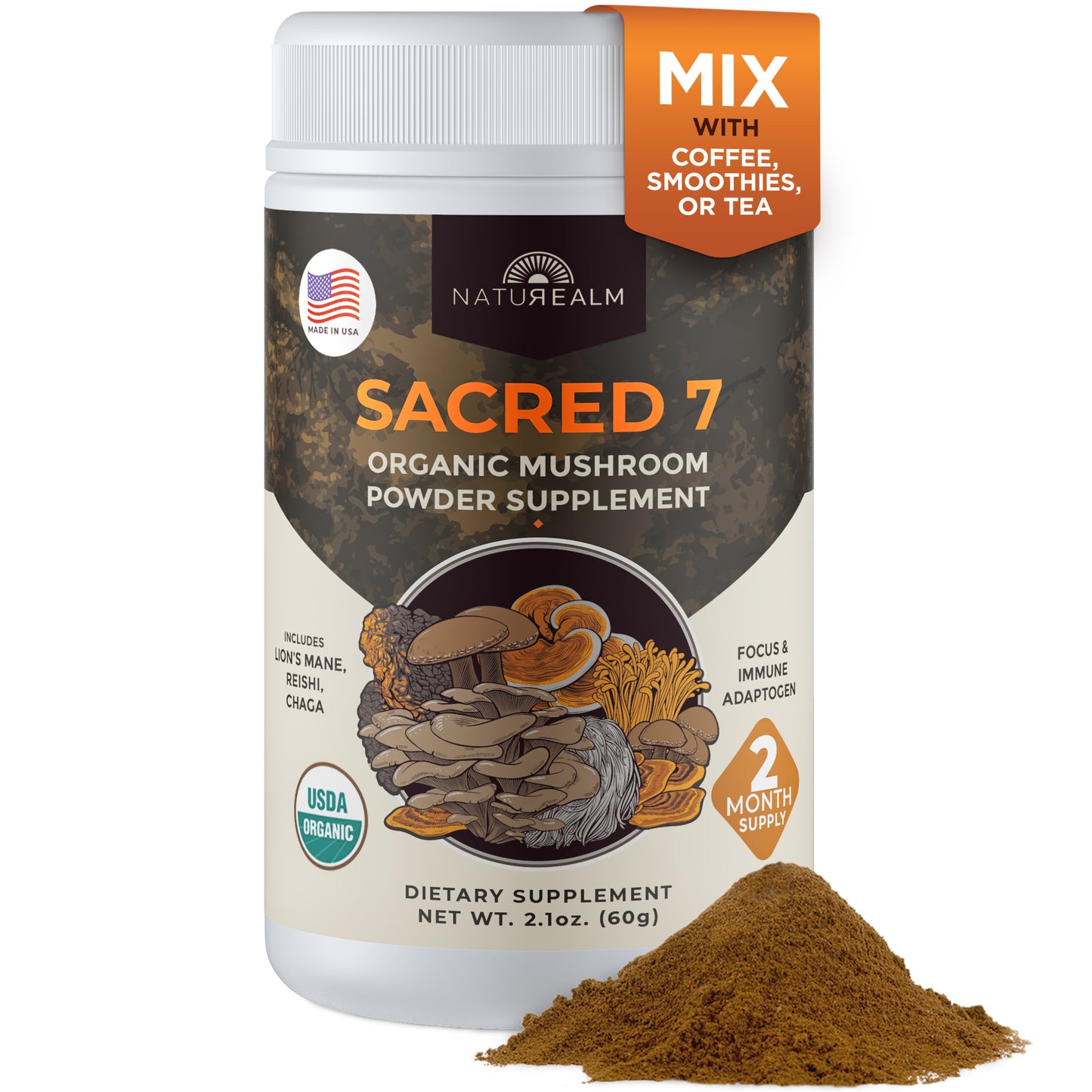
| Your coffee + Sacred 7 | Add-in powder | Whatever your coffee has | Naturealm |
What Should You Look for in a Mushroom Coffee Alternative?

Look for per-species dosing, fruiting body extracts, third-party testing, and a stated caffeine number. These four things separate a serious product from a branded powder.
- Per-species dosing: the label lists milligrams for each mushroom, not one blend total. A single total can hide a token amount of the mushroom you actually want.
- Fruiting body extracts: the extract comes from the mushroom itself, not the mycelium (root network). Mycelium is usually grown on grain, and some of that grain can end up in the powder.
- Third-party testing: an independent lab, not the brand, confirms what's in the product. Ask for a certificate of analysis (COA).
- Caffeine disclosure: the label gives an exact number. Many mushroom coffees say "contains caffeine" and stop there.
For the full label checklist, see How to Choose a Mushroom Supplement Blend: 5 Things to Check on the Label.
Where Can You Buy a Mushroom Extract Without the Guesswork?
You can buy Sacred 7 Powder directly from Naturealm and skip the label decoding.
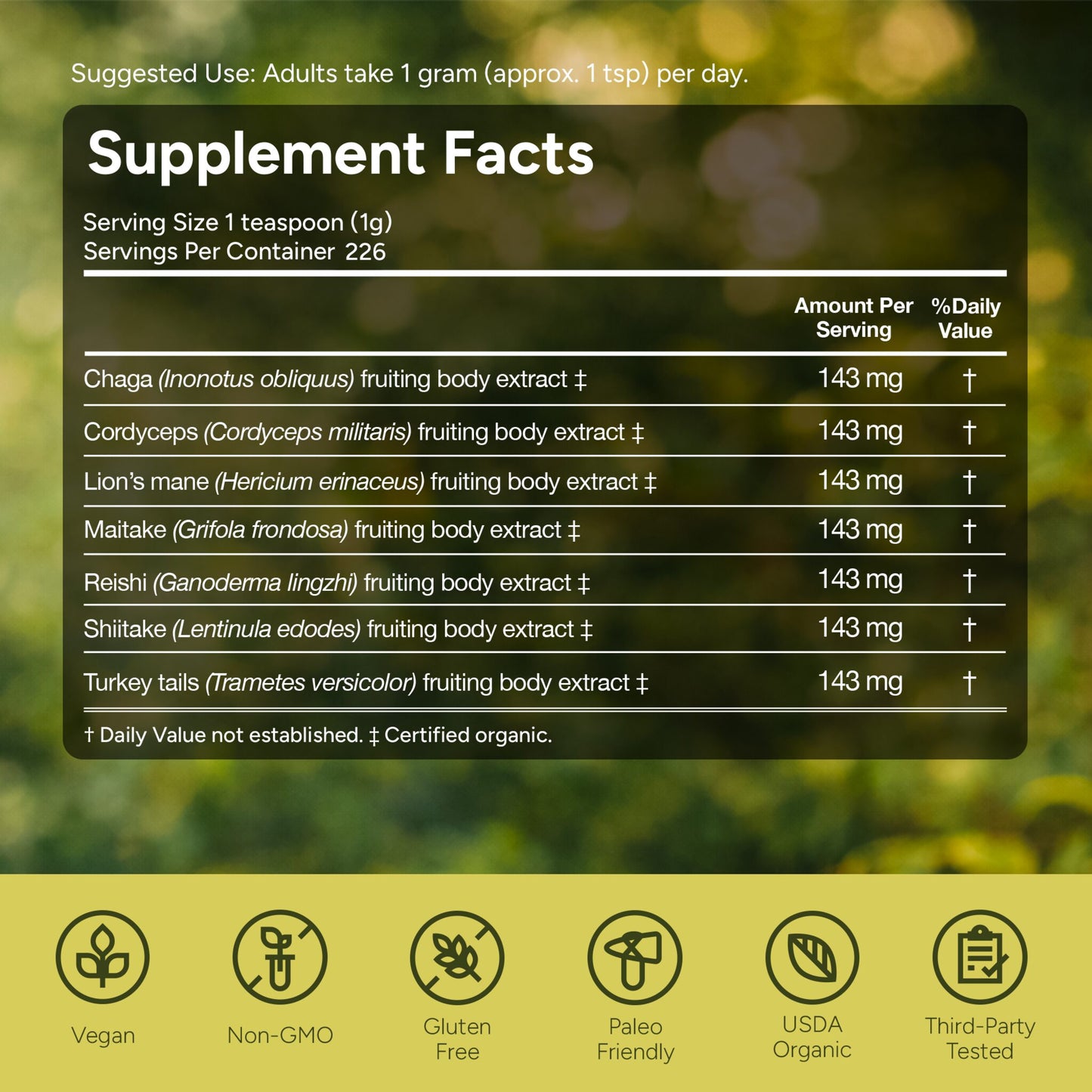
Every serving lists its dose per mushroom: 143mg each of seven mushrooms, 1,000mg total in one level teaspoon. The extract is 100% fruiting body, hot water extracted, certified organic, and third-party tested by Mérieux NutriSciences. There's no coffee in it, so it works in the cup you already make, whether that's drip, espresso, or cold brew, and in tea or a smoothie later in the day.
Should You Add Mushroom Extract to Your Own Coffee or Buy a Blend?
Adding an extract to your own coffee gives you the most control, because the coffee and the mushrooms stay separate. You keep your beans, roast, and caffeine level, and you choose the dose.
Pre-mixed blends are convenient: one scoop and you're done. They also lock you into their coffee. Most use instant coffee, and the mushroom dose is fixed. A separate extract lets you:
- Keep a coffee you already love
- Use mushrooms without caffeine later in the day
- Adjust the dose without changing your coffee
The trade-off is one extra step: a teaspoon and a stir, or a few seconds with a frother. For a side-by-side of formats, see Mushroom Coffee vs. Mushroom Powder vs. Capsules. For step-by-step mixing, see Can You Add Mushroom Powder to Coffee?
What Is the Best Caffeine-Free Mushroom Coffee Alternative?
Rasa is the most-recommended caffeine-free option. Teeccino is the lower-priced alternative. Both replace coffee with roasted roots, so the cup looks and tastes coffee-like without any caffeine.
Rasa is a woman-owned Public Benefit Corporation from Boulder, Colorado, whose base blends roasted chicory root, date seed, and burdock root, with adaptogenic herbs and mushrooms added. Teeccino makes a full line of caffeine-free herbal coffees, several with added mushrooms.
For a caffeine-free cup with a higher mushroom dose, stir Sacred 7 into herbal coffee or tea, or take three Sacred 7 capsules instead.
One caution: Reishi may increase bleeding risk when taken with blood thinners. Anyone on anticoagulants should check with a doctor first. More in Best Reishi Supplement: What to Look For.
What Is a Good Alternative to Ryze Mushroom Coffee?
The most common Ryze alternatives are Atlas+ for a better-reviewed instant, and MUD\WTR for lower caffeine.
Ryze tends to rank low with taste testers. Chowhound placed it seventh of eight and was unimpressed with its flavor and quality. It contains six mushrooms and about 48mg of caffeine per serving, and a 30-serving bag runs about $44.99, or roughly $1.50 per cup.
If you picked Ryze to get mushrooms into your morning, the simplest swap is your usual coffee plus a teaspoon of extract. For more options, see The Best Ryze Alternatives, Compared.
Which Mushroom Coffee Alternative Tastes Best?
Brewed options taste the most like coffee. Instant powders get the most taste complaints.
A dietitian testing brewed Four Sigmatic found it looks, smells, and tastes just like coffee. Among instants, one comparison found Atlas+ smooth and low-acid with no mushroom aftertaste.
Flavor masking is the common fix. Cacao, chai spices, coconut, and sweeteners cover the earthy notes, which is why so many blends are really lattes.
Adding a hot water extract to brewed coffee avoids most of this. The coffee carries the flavor, the mushrooms add a mild earthy note, and a splash of milk smooths it out. (For more, see Why Mushroom Coffee Tastes Bad, and How to Make It Taste Good.)
How Much Caffeine Is in a Mushroom Coffee Alternative?
Most mushroom coffee alternatives have 35 to 50mg of caffeine per serving, about half a regular cup. The full range runs from zero to a regular cup's worth, so check the label.
The reduction comes from dilution. Mushrooms contain no caffeine, so blends that swap coffee for mushroom powder carry less.

| Product | Caffeine per serving |
|---|---|
| Rasa, Teeccino | 0mg |
| Sacred 7 Powder (on its own) | 0mg |
| MUD\WTR Original | About 35mg |
| Atlas+ Superblend | About 45mg |
| Ryze | About 48mg |
| Four Sigmatic instant | 50mg (half-caf) |
| Regular brewed coffee, 8oz | About 95mg |
The FDA cites 400mg a day as an amount most healthy adults can have, about two to three 12-ounce cups of coffee. For a full side-by-side, see Mushroom Coffee vs. Regular Coffee.
Do Mushroom Coffee Alternatives Actually Work?
No human trial has tested a finished mushroom coffee product. The research exists at the ingredient level, usually at doses much larger than a coffee serving delivers.
- Lion's Mane: Docherty, Doughty, and Smith (2023, Nutrients) gave 41 healthy young adults 1.8g of Lion's Mane a day. After a single dose, they completed a Stroop test faster an hour later. The authors noted the study was too small to reliably detect modest effects. More in Best Lion's Mane Supplement: Fruiting Body vs. Mycelium, Explained.
- Cordyceps: Chen and colleagues (2010, Journal of Alternative and Complementary Medicine) gave older adults 3g of Cs-4 Cordyceps daily for 12 weeks. Their metabolic threshold improved during exercise.
The gap is dose. Those trials used grams of a single mushroom. Most mushroom coffees contain a few hundred milligrams split across four to six species. That's why per-species labeling matters: it's the only way to know what you're getting. It's also why an extract you dose yourself, or a single-mushroom product like Lion's Mane Extract Powder, makes more sense if one mushroom matters most to you. For a full look at the value question, see Is Mushroom Coffee Worth It? What the Research Actually Shows.
What Quality Problems Should You Avoid?
Avoid grain filler, proprietary blends, hidden sweeteners, and subscription lock-in. All four are visible before you buy.
- Grain filler: mycelium grown on rice or oats can carry grain starch into the powder. A "polysaccharides" number on the label doesn't separate starch from beta-glucans. McCleary and Draga (2016, Journal of AOAC International) published the method that does: measure total glucan, measure starch separately, and report beta-glucan as the difference.
- Proprietary blends: one combined total for several species, with no per-mushroom amounts.
- Hidden sweeteners: sugar that arrives through creamers or "natural flavors" instead of being named plainly.
- Subscription lock-in: recurring orders that are hard to pause or cancel.
How Much Does a Mushroom Coffee Alternative Cost?
Most mushroom coffee alternatives cost $1 to $2 per serving. Instant lattes sit at the high end, and ground blends at the low end.
Ryze works out to about $1.50 per cup. Sacred 7 Powder's 8 oz bag is $69.99, which comes to about $0.31 per one-teaspoon serving, on top of the coffee you already buy.
Check the serving size before comparing prices. Some labels call for two scoops per cup, which doubles the real cost.
Is Matcha a Good Alternative to Mushroom Coffee?
Matcha is the closest tea-based swap. It pairs moderate caffeine with L-theanine, an amino acid that smooths out the lift. The difference from mushroom coffee is mostly in how the energy feels, not how strong it is. Mushroom extract powder stirs into matcha too, if you want both.
These statements have not been evaluated by the Food and Drug Administration. This product is not intended to diagnose, treat, cure, or prevent any disease.