

Fruiting Body vs. Mycelium: Why It's the Only Question That Matters in Mushroom Supplements
I didn't come to functional mushrooms as a founder. I came as a skeptic.
When I started researching mushroom supplements seriously, the first thing I noticed was how hard it was to get a straight answer about what was actually inside the capsules. Every brand had the same confidence. The labels all sounded credible. But the deeper I looked, the more I realized most of the industry was built on a quiet substitution that most consumers never catch.
The substitution: mycelium for fruiting bodies. Filler for function.
Here's what you need to know before you spend another dollar on a mushroom supplement.
What Is the Fruiting Body?
The fruiting body is the part most people picture when they think "mushroom." It's the cap, the stem, the visible structure that emerges from the ground or a log. For the fungus, it's the reproductive endpoint — the place where all accumulated nutrients land before spores are released.
That concentration matters. The fruiting body is where you'll find the highest density of bioactive compounds: beta-glucans (the polysaccharides responsible for most immune-supporting activity), triterpenes (found in high concentrations in Reishi, associated with liver function and stress modulation), and the full expression of what makes each species medicinally distinct.
Lion's Mane fruiting bodies, for example, contain hericenones. Hericenones are unique to the fruiting body and are one of the compounds studied for their potential neurological effects. You cannot get them from mycelium.
What Is Mycelium?
Mycelium is the fungal root system. When spores land on a substrate, they grow into thin filaments called hyphae. Those hyphae extend, branch, and interconnect to form the fungal mycelium network that eventually produces a fruiting body.
The job of fungal mycelium is transport and survival: pulling water and nutrients from the substrate, warding off competing organisms, and channeling energy toward fruit production. It does contain some useful compounds, particularly antibiotic and antiviral ones. And erinacines, another Lion's Mane compound studied for neurological benefit, are found exclusively in the mycelium, not the fruiting body.
So mycelium isn't worthless. But that's not the real problem.
The problem is what mycelium-based supplements are actually made of.
The Grain Substrate Problem
Commercial mycelium for supplements is almost always grown on a grain substrate. Brown rice, oats, or sorghum are common. Here's the part the label doesn't say: once mycelium colonizes grain, the two become inseparable. You cannot extract the mycelium cleanly. So the whole thing — grain and all — gets dried and ground.
What you're left with is mycelium grown on grain. Not a mushroom extract. A grain powder with some fungal matter in it.
This is not a fringe issue. It's one of the most widespread problems in the supplement category — and it's been accelerating as demand for functional mushrooms outpaces supply of quality fruiting bodies.
Look at the supplement facts panel on most "mushroom" products sold in big-box stores. If starch shows up as a significant component, that's your answer. High starch = mostly grain. High beta-glucans = actual mushroom material.
Some producers use liquid fermentation to create a purer mycelium extract, and those products are meaningfully better. But they still don't reach the potency of a well-produced whole mushroom extract from fruiting bodies.
What a Real Mushroom Supplement Actually Is
A fruiting body-based mushroom supplement starts with whole mushrooms. Reishi, Lion's Mane, Chaga, Cordyceps, Turkey Tail, Shiitake, Maitake. Each species, grown or harvested at maturity, then processed to make its bioactive compounds accessible to the body.
Hot water extraction is the standard for powders and capsules. The process breaks down the tough chitin cell walls that would otherwise block absorption, releasing polysaccharides and other water-soluble compounds in a form your body can use. For compounds like the triterpenes in Reishi — which are alcohol-soluble rather than water-soluble — a dual extraction (hot water plus ethanol) captures the full spectrum.
Understanding extraction methods is the single fastest way to separate a quality product from a low-quality one. And whether you take powders or capsules, the extraction question matters equally for both.
The result of proper extraction: a genuine mushroom extract, concentrated, bioavailable, and actually representative of the species on the label.
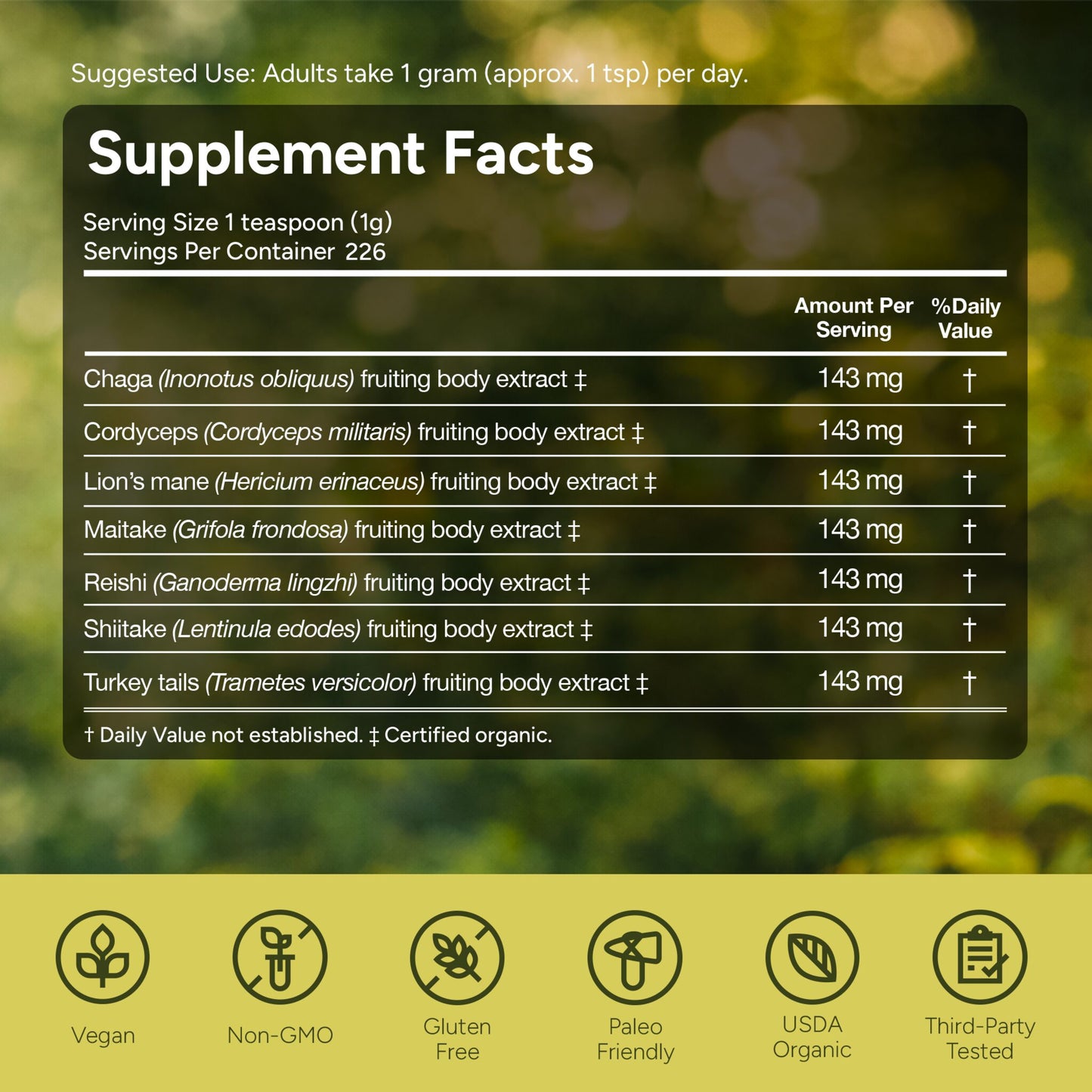
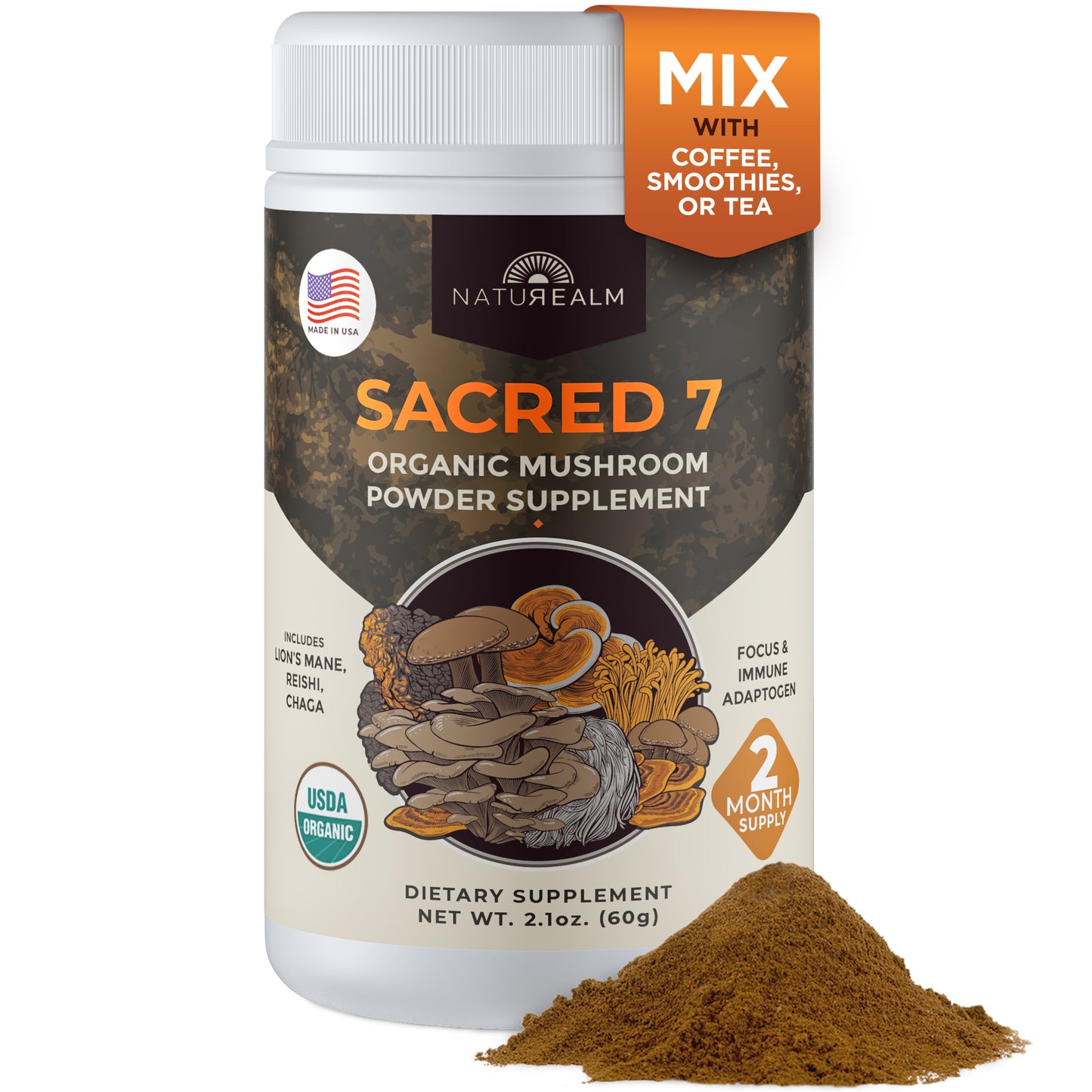
Sacred 7 uses 100% fruiting bodies. Hot water extraction. USDA Organic. Seven species, nothing else.
Shop Sacred 7 Powder Shop CapsulesThe Species That Matter Most
Each mushroom in a well-formulated blend earns its place. Here's what the research actually says about the seven species in Sacred 7.
Lion's Mane
Contains hericenones in the fruiting body, studied for neurological and cognitive support. Note: erinacines, also studied for brain health, come from Lion's Mane mycelium — which is one reason some research uses both parts. For most commercial mushroom supplements, fruiting body remains the higher-quality standard. Lion's Mane is also one of the more extensively studied species for gut health support alongside its neurological applications.
Reishi
Dense in triterpenes and beta-glucans. Dual extraction is important here to access the alcohol-soluble triterpene fraction — which is why Reishi tinctures use both hot water and ethanol, while the Sacred 7 powder captures the water-soluble polysaccharides through hot water extraction.
Cordyceps
Provides adenosine and cordycepin, associated with energy and oxygen utilization. The cultivated species used in supplements is Cordyceps militaris — a fruiting body-producing species, which means you can get a true fruiting body extract, unlike the original Cordyceps sinensis which cannot be commercially cultivated.
Turkey Tail
One of the most extensively studied mushroom species for immune modulation, primarily via its polysaccharide content. The research base here is substantial — Turkey Tail has been studied in clinical contexts more than almost any other functional mushroom.
Chaga
Technically a fungal growth (sclerotia) rather than a traditional fruiting body, harvested from Birch trees. Wild-harvested is strongly preferred — it's a slow-growing organism that draws its compounds from the Birch host over years. Naturally high in antioxidant compounds, with some of the highest measured ORAC values of any natural substance.
Shiitake
Well-documented beta-glucan profile and one of the most researched culinary-medicinal mushrooms. Lentinan, a specific polysaccharide from Shiitake, has been studied extensively for immune function.
Maitake
Rounds out an immune-supportive blend with its own distinct beta-glucan fractions. The D-fraction from Maitake has been studied for its effects on immune response.
All seven are in Sacred 7. All fruiting body. All extracted. And there's a reason a blend outperforms a single species — the synergy between these compounds is part of what makes the formula work.
Seven species. One daily practice. Subscribe & Save and lock in your supply.
Shop Sacred 7 Powder Shop CapsulesHow to Read a Mushroom Supplement Label
Before you buy anything — from us or anyone else — here's what to look for.
Look for: "100% fruiting body" clearly stated. "Hot water extract" or "dual extract" for tinctures. Beta-glucan content listed (the higher the percentage, the better). A named extraction method, not just "extract."
Avoid: "Full spectrum" or "mycelium biomass" without explanation. No mention of extraction method. Starch listed on the supplement facts panel. Proprietary blends with no per-ingredient breakdown. The phrase "mycelium grown on grain" buried in the fine print.
Ask the company: Where is the mushroom grown or harvested? What is the extraction method? Can they provide a Certificate of Analysis (COA)?
A company with nothing to hide answers those questions without hesitation. Most of the industry would rather you didn't ask.
And when you're ready to actually build a daily routine, here's when and how to take mushroom supplements for maximum effect — and whether combining different species makes sense for you.
Why I Chose Sacred 7
When I chose to work with Naturealm, the first thing I asked for was documentation. Lot records. Extraction methodology. Certificate of Analysis. Not because I assumed the worst — but because I'd spent enough time in this space to know that documentation is the minimum bar, not a bonus.
Sacred 7 uses 100% fruiting bodies. Hot water extraction only. USDA Organic. Seven species: Lion's Mane, Reishi, Cordyceps, Chaga, Turkey Tail, Shiitake, and Maitake. No mycelium. No grain substrate. No filler.
That clarity is not industry standard. It should be. But it isn't.
I didn't start Sacred 7. I chose it. There's a difference — and after everything I've read about this category, that choice is not one I make lightly.
Try Sacred 7 for 30 days. One serving daily. See what properly extracted functional mushrooms actually feel like.
Shop Sacred 7 Powder Shop CapsulesThe Bottom Line
The mushroom supplement market is largely unregulated and heavily marketed. The gap between what's on the front of the label and what's in the capsules can be enormous.
- Fruiting bodies contain the bioactive compounds you're looking for.
- Mycelium grown on grain is mostly grain.
- Hot water extraction makes those compounds bioavailable.
- High starch on a label is a red flag. High beta-glucans is a green one.
- Any brand worth buying will hand over documentation without being asked twice.
You don't have to take my word for it. Ask for the documentation. And if you want to understand exactly what makes a mushroom extract work — or not — start here.