


How Much Caffeine Is in Dark Chocolate?
Dark chocolate has about 23mg of caffeine per ounce at 70 to 85% cacao, according to USDA data, or roughly 8mg in a typical 10-gram square. That's about a quarter of an 8-ounce cup of brewed coffee, which has about 95mg. The caffeine lives in the cocoa solids, so 45 to 59% dark has about half as much, milk chocolate about a quarter, and white chocolate none. Dark chocolate also carries roughly ten times as much theobromine, a gentler relative of caffeine. Real bars vary with the bean and where it was grown, so treat these as averages. The calculator below adds your chocolate to the rest of your day.
How Much Caffeine Is in Dark Chocolate?
About 23mg per ounce for 70 to 85% cacao, about 24mg for 60 to 69%, and about 12mg for 45 to 59%.
These are the U.S. Department of Agriculture's averages from FoodData Central, measured per 100 grams and converted to everyday portions. Most bars are 85 to 100 grams, and a single square is usually around 10 grams, so check your wrapper's serving size.

| Chocolate | Per 100g | Per 1 oz (28g) | Per 10g square |
|---|---|---|---|
| Dark, 60 to 69% cacao | 86mg | 24mg | 9mg |
| Dark, 70 to 85% cacao | 80mg | 23mg | 8mg |
| Dark, 45 to 59% cacao | 43mg | 12mg | 4mg |
| Milk chocolate | 20mg | 6mg | 2mg |
| White chocolate | 0mg | 0mg | 0mg |
| Unsweetened cocoa powder | 230mg | 65mg | 12mg per tablespoon |
A whole 100-gram bar of 70 to 85% dark chocolate comes to about 80mg, close to a cup of brewed coffee. That's the number most people don't expect: two squares after dinner is a rounding error, and half a bar while you work is a real dose.
Does Higher Cacao Always Mean More Caffeine?
Mostly, yes, because caffeine comes from the cocoa solids, but the bean matters too.
Milk, sugar, and cocoa butter carry no caffeine, so the more of the bar they make up, the lower the number. That's why milk chocolate lands near 20mg per 100 grams and white chocolate, which is cocoa butter without the solids, has none. The relationship isn't perfectly tidy. In the USDA data, the 60 to 69% category measures slightly higher than 70 to 85%, and chocolate makers who test their own bars report wide swings between beans from different countries. Think of the cacao percentage as a good first guess, not a precise reading.
Where Does Sacred 7 Fit With Chocolate?
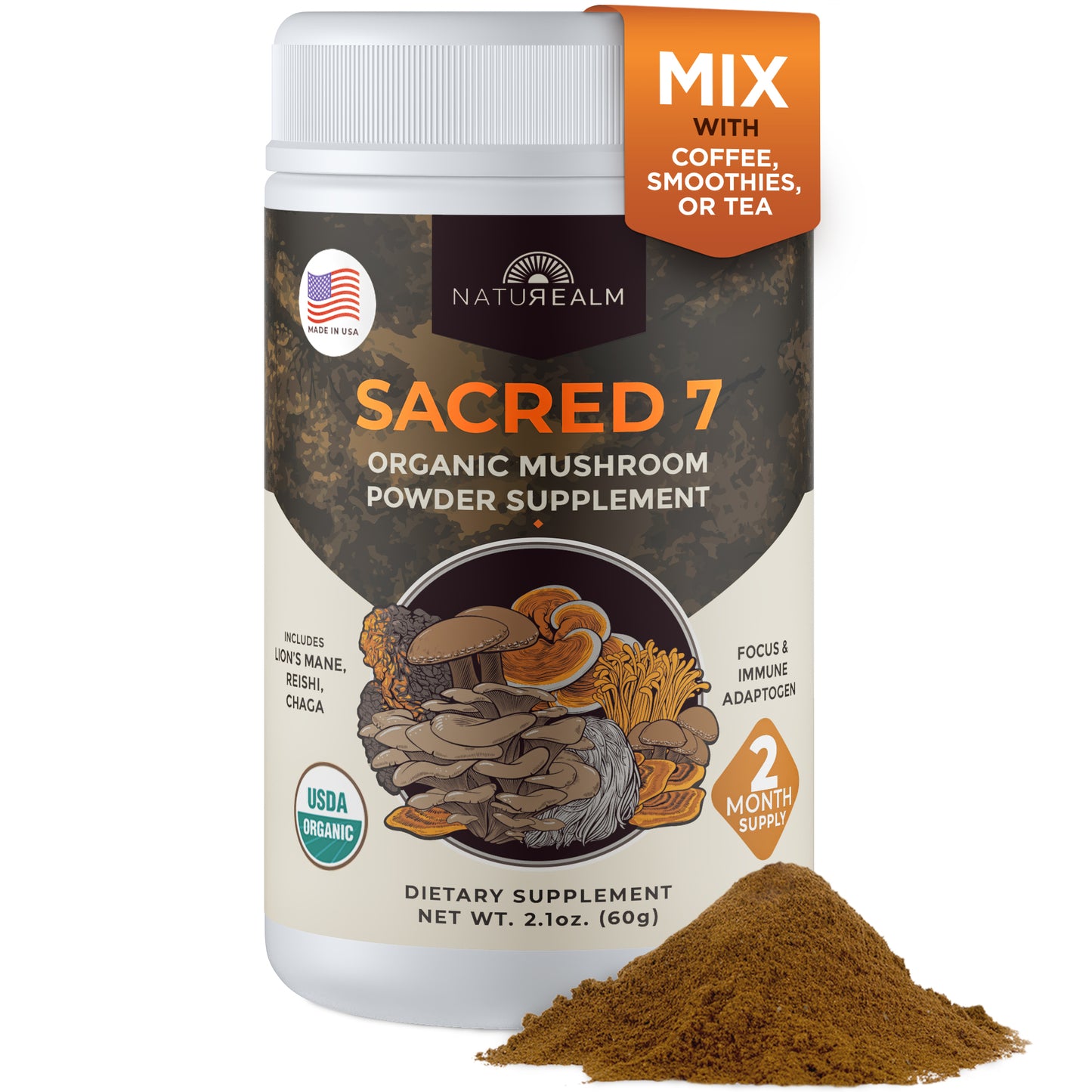
If you love chocolate in a mug, Sacred 7 Mushroom Extract Powder stirs straight into hot cacao and adds no caffeine of its own.
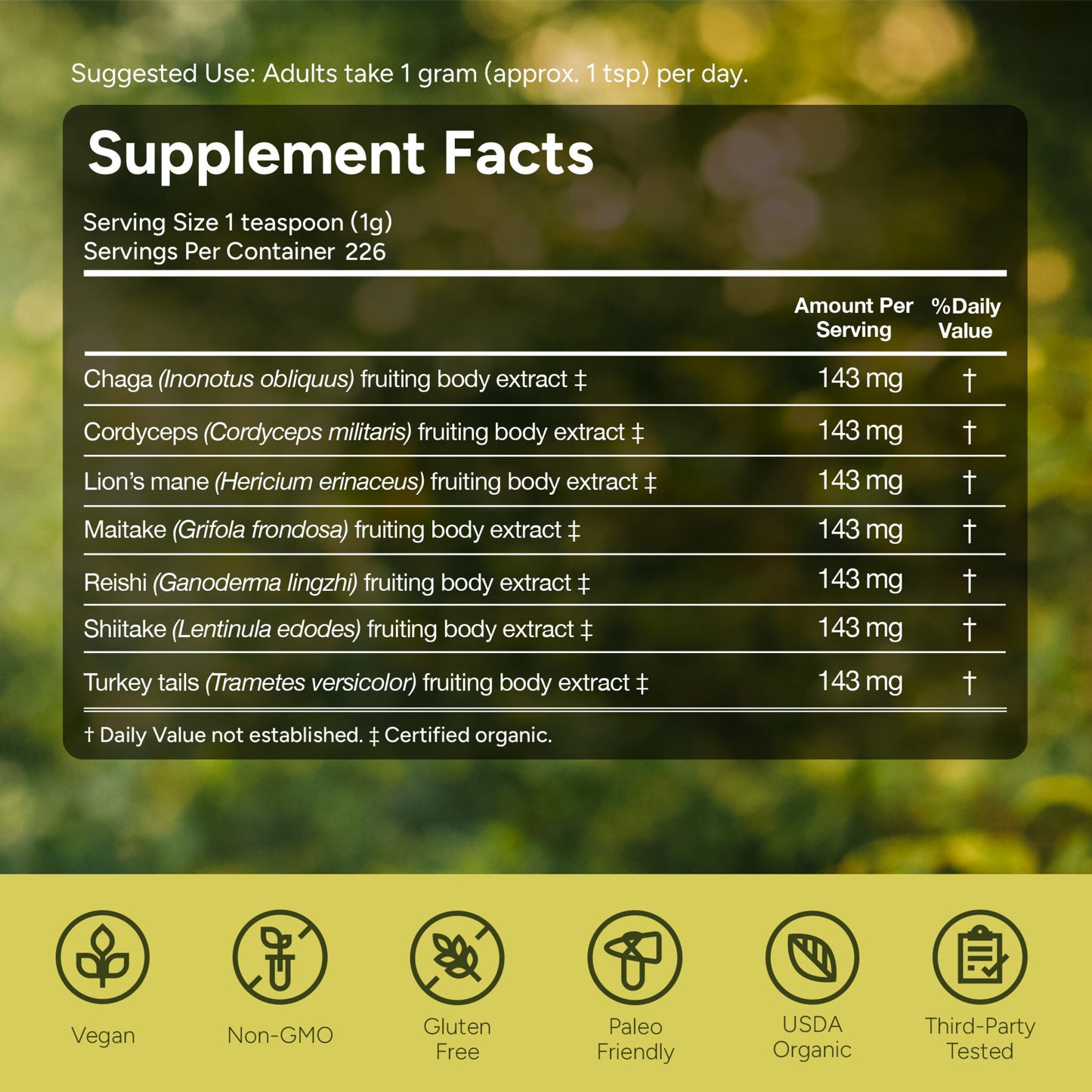
One level teaspoon holds 1,000mg of hot water extract from seven mushrooms: Lion's Mane, Reishi, Chaga, Cordyceps, Turkey Tail, Shiitake, and Maitake, 100% fruiting body and certified organic. It naturally smells a little like chocolate, so it disappears into a mug of cocoa instead of competing with it. With a tablespoon of unsweetened cocoa, the whole mug lands around 12mg of caffeine. Here's the mushroom hot chocolate recipe.
How Much Caffeine Is in Your Whole Day?
Chocolate is usually the smallest line on the list, which is why it's worth counting it alongside everything else. Pick your chocolate by type and grams from the wrapper, then add your coffee, tea, and soda.
Your Day
Example day loadedWhat's Left When You Lie Down
0 mg still circulating
Based on an average 5-hour half-life.
Trade One Coffee for Sacred 7
Add a coffee to see how much a Sacred 7 swap would take off your total.
Seven fruiting body mushrooms in every teaspoon, with no caffeine of its own.
Typical amounts from the FDA, USDA FoodData Central, and Mayo Clinic. Real caffeine varies with the bean, the leaf, and the brew, so use your label when you have one. For general education, not medical advice. Open the full-page calculator.
What Is Theobromine, and Does It Keep You Awake?
Theobromine is caffeine's milder chemical cousin, and at the amounts in chocolate it doesn't seem to act like a stimulant.
Dark chocolate at 70 to 85% cacao has about 802mg of theobromine per 100 grams, roughly 225mg in an ounce, which is about ten times its caffeine. Two human studies help put that in context:

- Baggott and colleagues (2013, Psychopharmacology) gave 84 healthy adults 250, 500, or 1,000mg of theobromine, 200mg of caffeine, or a placebo. The 250mg dose, close to an ounce of dark chocolate, barely changed mood and didn't significantly raise heart rate. Higher doses raised heart rate, and 1,000mg made people feel worse, not more alert. Caffeine did what caffeine does. The authors called the findings preliminary (study).
- Mitchell and colleagues (2011, Physiology & Behavior) compared 700mg of theobromine with 120mg of caffeine in 24 healthy women. Caffeine raised alertness for up to three hours. Theobromine didn't, and it lowered blood pressure slightly at the one-hour mark. The sample was small and included only women (study).
The takeaway: the caffeine is the part of chocolate most likely to nudge your alertness, and theobromine mostly isn't. Theobromine also lingers longer, with a half-life Baggott's team put at about 7 to 12 hours, compared with 2.5 to 5 hours for caffeine.
Can Dark Chocolate Keep You Up at Night?
A square or two is unlikely to matter for most people, while a big bar late in the evening adds up to roughly a cup of coffee.
I haven't found a sleep study that tests chocolate itself, so the honest answer comes from the caffeine math. In a study at the Henry Ford Hospital sleep center, Drake and colleagues found that 400mg of caffeine taken even 6 hours before bed cut total sleep time by more than an hour (Journal of Clinical Sleep Medicine, 2013). Two squares of 70% dark chocolate carry about 16mg, a small fraction of that. Half a 100-gram bar is about 40mg, close to a can of cola.
If you're sensitive to caffeine, keep larger portions earlier in the day, or choose a 45 to 59% bar after dinner. The bedtime check in the calculator above shows roughly how much of your day's caffeine is still circulating when you lie down. For timing the rest of your routine, see when to take mushroom supplements.
How Does Dark Chocolate Compare With Coffee, Tea, and Hot Cocoa?
Ounce for ounce, dark chocolate carries more caffeine than brewed coffee, but you eat far less of it.

| Item | Serving | Caffeine (approx.) |
|---|---|---|
| Brewed coffee | 8 oz | 95mg |
| Espresso | 1 shot | 64mg |
| Black tea | 8 oz | 47mg |
| Cola | 12 oz can | 34mg |
| Dark chocolate, 70 to 85% | 1 oz | 23mg |
| Mushroom hot chocolate with Sacred 7 | 1 mug | 12mg |
| Hot cocoa from a mix | 1 mug | 4mg |
Coffee, tea, and cola figures are typical values from the Mayo Clinic and the FDA, which cites 400mg a day as an amount not generally linked to negative effects for most healthy adults. If you're trying to cut back, chocolate is rarely the place to start. The afternoon coffee usually is, and our 3-week caffeine taper planner maps that out. For caffeine-free mug ideas, see Mushroom Coffee Without Caffeine.
Frequently Asked Questions
How Much Dark Chocolate Equals a Cup of Coffee?
About 4 ounces, or most of a 100-gram bar, of 70 to 85% dark chocolate. That's roughly 90 to 95mg of caffeine, close to an 8-ounce cup of brewed coffee.
Does White Chocolate Have Caffeine?
No. White chocolate is made from cocoa butter, milk, and sugar, without the cocoa solids where caffeine lives, so USDA lists it at 0mg.
Does Cocoa Powder Have More Caffeine Than Dark Chocolate?
By weight, yes: unsweetened cocoa powder has about 230mg per 100 grams, nearly three times as much as 70 to 85% dark chocolate. You use much less of it, though, so a tablespoon in a mug comes to about 12mg.
Does Chocolate Count Toward a Daily Caffeine Limit in Pregnancy?
Yes. The American College of Obstetricians and Gynecologists suggests keeping caffeine under 200mg a day during pregnancy, and chocolate counts toward that total. Check with your provider about what's right for you.
Do Mushrooms Have Caffeine?
No. Lion's Mane, Reishi, Chaga, Cordyceps, Turkey Tail, Shiitake, and Maitake contain no caffeine, so any caffeine in a mushroom drink comes from the coffee, tea, or cocoa you mix it into.
These statements have not been evaluated by the Food and Drug Administration. This product is not intended to diagnose, treat, cure, or prevent any disease.