

Best Cordyceps Supplement: How to Choose (Militaris vs. Sinensis)
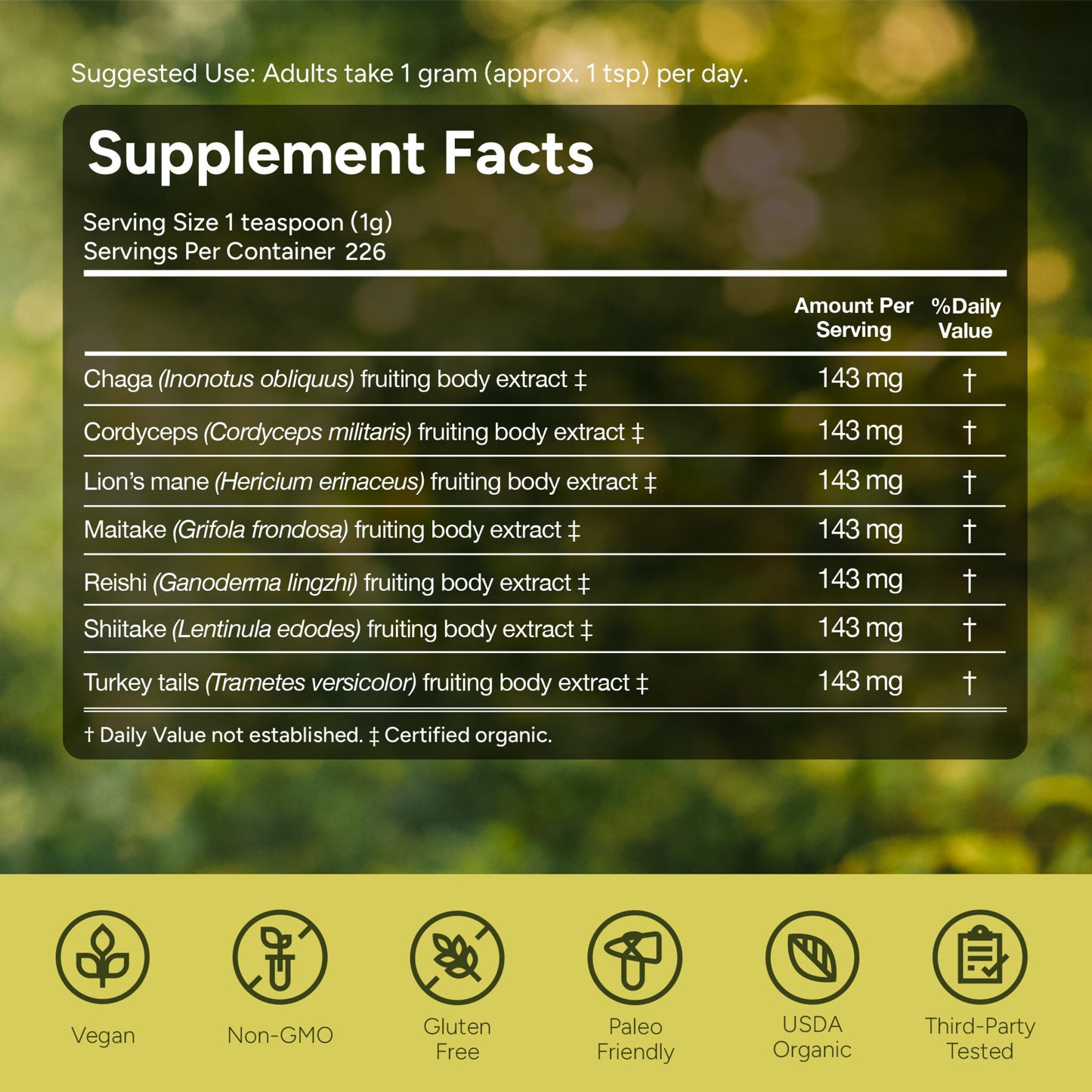
The best Cordyceps supplement tells you exactly what's inside: the species, the part of the mushroom, and how many milligrams per serving. Cordyceps militaris fruiting body extract is the easiest to verify, because militaris can be grown as a real mushroom and is known for cordycepin. Most products labeled "Cordyceps sinensis" aren't wild sinensis, which is listed as vulnerable and can cost more than gold. They usually contain Cs-4, a fermented strain that genetic testing identified as a different fungus. Human studies used 1 to 4 grams of Cordyceps a day. Sacred 7 holds 143mg of Cordyceps militaris fruiting body extract per teaspoon, inside a daily blend of seven mushrooms.

What Should You Look for in a Cordyceps Supplement?
Look for five things on the label: the species, the part of the mushroom, extract or raw powder, a milligram amount, and third-party testing.
- Species: the label should say Cordyceps militaris, or name the strain if it's "sinensis" (Cs-4 is the most common). "Cordyceps" alone tells you very little, because the name covers several different fungi with different chemical profiles.
- Fruiting body or mycelium: the fruiting body is the mushroom itself. Mycelium is the root-like network, often grown on grain. Look for the words "fruiting body" on the label.
- Extract or raw powder: an extract has been processed, usually with hot water, to concentrate compounds from the mushroom. Raw ground powder hasn't.
- Milligrams per serving: a blend should list how much Cordyceps you're getting, not just a total for the whole blend.
- Third-party testing: an independent lab confirms what's in the product. Ask the brand for a certificate of analysis if it isn't posted.
Cordyceps Militaris vs. Sinensis: Which Is Better?
Cordyceps militaris fruiting body is the easiest to verify and to buy at a fair price. Here's what each name on a label usually means.
| What the label says | What it usually is | Worth knowing |
|---|---|---|
| Wild Cordyceps sinensis | Wild Ophiocordyceps sinensis from the Tibetan Plateau | Rare, costly, and listed as vulnerable; rarely in supplements |
| Cordyceps sinensis Cs-4 | A fermented mycelium strain | Genetic testing identified it as Samsoniella hepiali, a related fungus; used in most "sinensis" studies |
| Cordyceps militaris fruiting body | The cultivated orange mushroom | Grown as a real fruiting body; known for cordycepin |
| Cordyceps mycelium on grain | Mycelium plus the grain it grew on | Hard to tell how much is mushroom and how much is grain |
Wild sinensis was listed as vulnerable by the IUCN in 2020 after overharvesting cut populations by at least 30% in 15 years, and it can sell for up to three times the price of gold by weight. That's why almost no supplement uses it. Most "sinensis" products use Cs-4, which was originally thought to be sinensis until genetic studies showed it's Samsoniella hepiali, a different genus in the same broader family. The old label stuck.
Cordyceps militaris can be cultivated as a whole fruiting body, the bright orange club-shaped mushroom, so you know you're getting the mushroom itself. It's grown on a grain substrate, and in a fruiting body product the substrate stays behind and never ends up in the jar.
Where Can You Get Cordyceps Militaris Fruiting Body Extract?
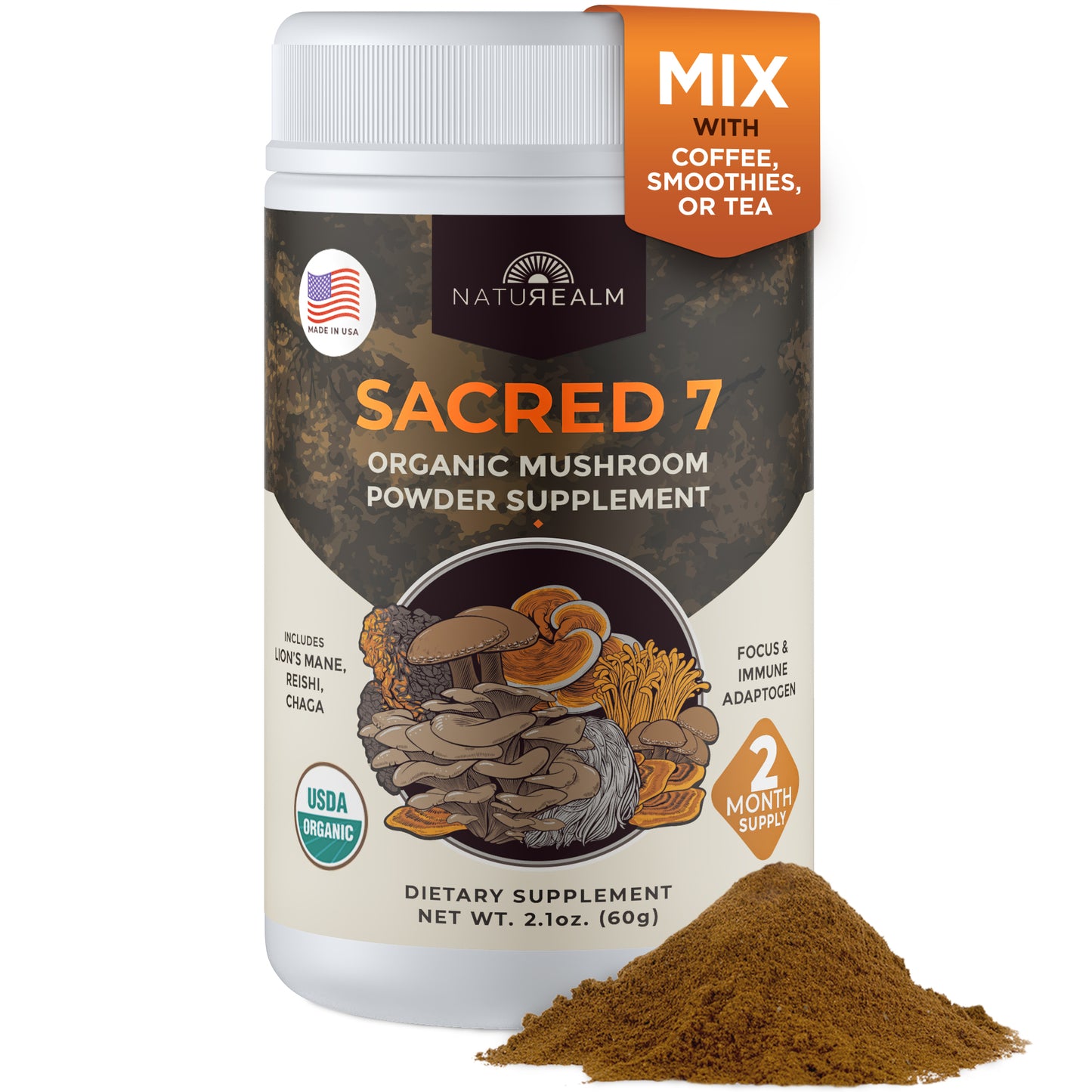
Sacred 7 Powder includes 143mg of Cordyceps militaris fruiting body extract in every level teaspoon, alongside Lion's Mane, Reishi, Chaga, Turkey Tail, Shiitake, and Maitake.
It checks every box above: the species is named, it's 100% fruiting body with no mycelium or grain, it's hot water extracted, every mushroom is listed at 143mg, and it's third-party tested by an independent lab. One teaspoon holds 1,000mg in total and stirs into coffee, tea, or a shake. Sacred 7 Capsules hold the same blend.
Is Fruiting Body or Mycelium Cordyceps Better?
For a label you can trust, fruiting body is the safer pick. Mycelium grown on grain is often sold with the grain still in it, which makes it hard to know how much of the powder is actually mushroom.
Mycelium has its place: Cs-4 is a mycelium product, and it's what most of the older human studies used. The issue is transparency: a fruiting body extract is easier to check, and a label that says "mycelium on organic brown rice" or "myceliated grain" is telling you part of the scoop is rice. For a deeper look, see Fruiting Body vs. Mycelium.
How Much Cordyceps Do You Need?
Most human studies used 1 to 4 grams of Cordyceps a day for 2 to 12 weeks.
Here's the honest comparison. A teaspoon of Sacred 7 holds 143mg of Cordyceps militaris, well under those study amounts, because it's built as a daily blend of seven mushrooms rather than a single-mushroom performance dose. The closest study to Sacred 7 tested a blend too: Cordyceps militaris with Reishi, Lion's Mane, Shiitake, and Turkey Tail at 4 grams a day, where gains showed up after 3 weeks. We walk through every study, including the ones that found no benefit, in Cordyceps for Endurance: What Athletes Should Know.
If Cordyceps is your main focus and you want study-level amounts, a single-mushroom Cordyceps militaris fruiting body extract will get you closer. Apply the same five label checks.
Is Cordyceps Safe to Take Every Day?
Cordyceps is generally well tolerated in short human studies, with a few cautions worth checking.
- Most trials ran 12 weeks or less, so long-term data is limited.
- Cordyceps may affect blood sugar and blood clotting. Check with your doctor if you take diabetes medication or blood thinners, or have surgery planned.
- There isn't enough research on use during pregnancy or breastfeeding.
One caution: Bring your full supplement list to your next appointment. Here's how to talk to your doctor about mushroom supplements.
Frequently Asked Questions
Does Cordyceps Come From Caterpillars?
Wild Cordyceps sinensis does: it grows from moth larvae in the high-altitude grasslands of the Tibetan Plateau. Cordyceps militaris in supplements is cultivated on a grain substrate, and Cs-4 is grown by fermentation, so neither involves insects.
Does Cordyceps Have Caffeine?
No. Cordyceps contains no caffeine. If you take it in coffee, the caffeine comes from the coffee.
What Is Cordycepin?
Cordycepin is a compound found in Cordyceps, best known in Cordyceps militaris. Its structure is similar to adenosine, one of the building blocks your cells use for energy. Most of the research on cordycepin is in cells and animals.
Is a Cordyceps Blend as Good as Cordyceps on Its Own?
It depends on your goal. A blend gives you a smaller amount of each mushroom in one daily serving. If you want one mushroom at study-level amounts, a single-mushroom product makes more sense. See how to choose a mushroom supplement blend.
These statements have not been evaluated by the Food and Drug Administration. This product is not intended to diagnose, treat, cure, or prevent any disease.