

Why Mushroom Powder? How One Teaspoon Fits Into What You Already Do
Mushroom powder is the easiest functional mushroom format to stick with, because it doesn't ask you to start a new routine. One level teaspoon of a mushroom extract powder stirs into the coffee, tea, smoothie, or oatmeal you already have every morning, so the habit rides on one you've had for years. It's also the most flexible format and usually the cheapest per serving: Sacred 7 Powder works out to about 31 cents a day in the 8 oz jar. Choose a fruiting body extract, tie it to something you do daily, and give it a few weeks, since the research on functional mushrooms is about steady daily use, not a single dose.
Why Choose Mushroom Powder Over Capsules, Gummies, or Mushroom Coffee?
Powder is the most flexible and usually the least expensive per serving, and it disappears into things you already eat and drink.

| Format | Best for | Trade-off |
|---|---|---|
| Mushroom extract powder | Anyone with a daily coffee, tea, smoothie, or breakfast habit | Earthy taste; needs a drink or food to go into |
| Capsules | Travel, no-taste, exact dosing | One more pill to remember; higher cost per serving |
| Tinctures | Adding by the dropper to any drink; dual extracted | Contain alcohol |
| Gummies | People who won't take anything else | Often low mushroom content and added sugar |
| Mushroom coffee | Replacing your coffee in one step | The mushroom dose is often small and hard to adjust |
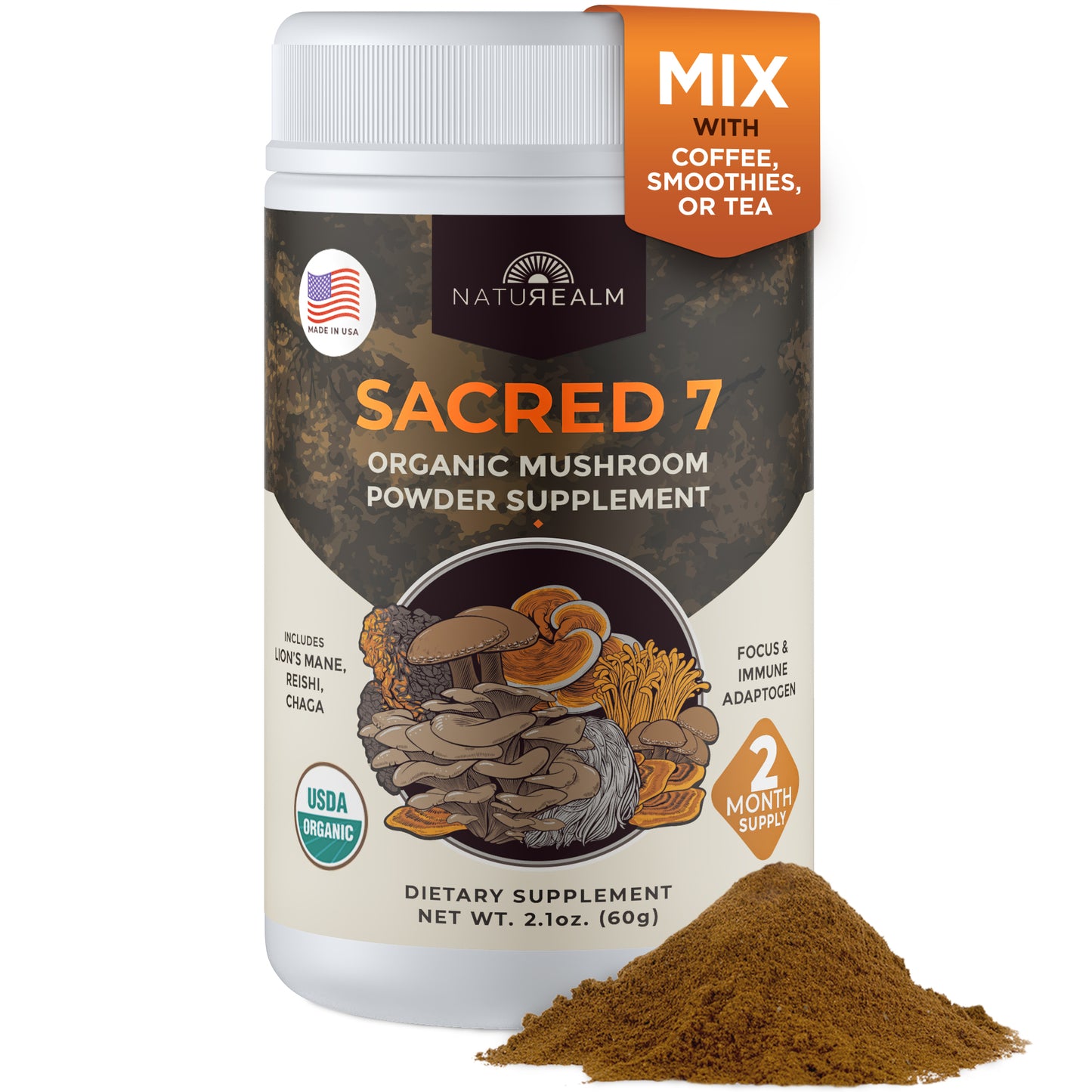
The cost math, using Naturealm prices: the 8 oz jar of Sacred 7 Powder is $69.99 for about 226 one-teaspoon servings, or about $0.31 a serving. The 2.1 oz jar is $34.99 for about 60 servings, or about $0.58. Sacred 7 Capsules are $45.99 for 180, and a serving is 3 capsules, so about $0.77 a serving. It's the same blend in each format; the powder just skips the capsule.
For a deeper side-by-side, see mushroom powders vs. capsules and mushroom powder vs. mushroom coffee.
What's Actually in One Teaspoon of Sacred 7?
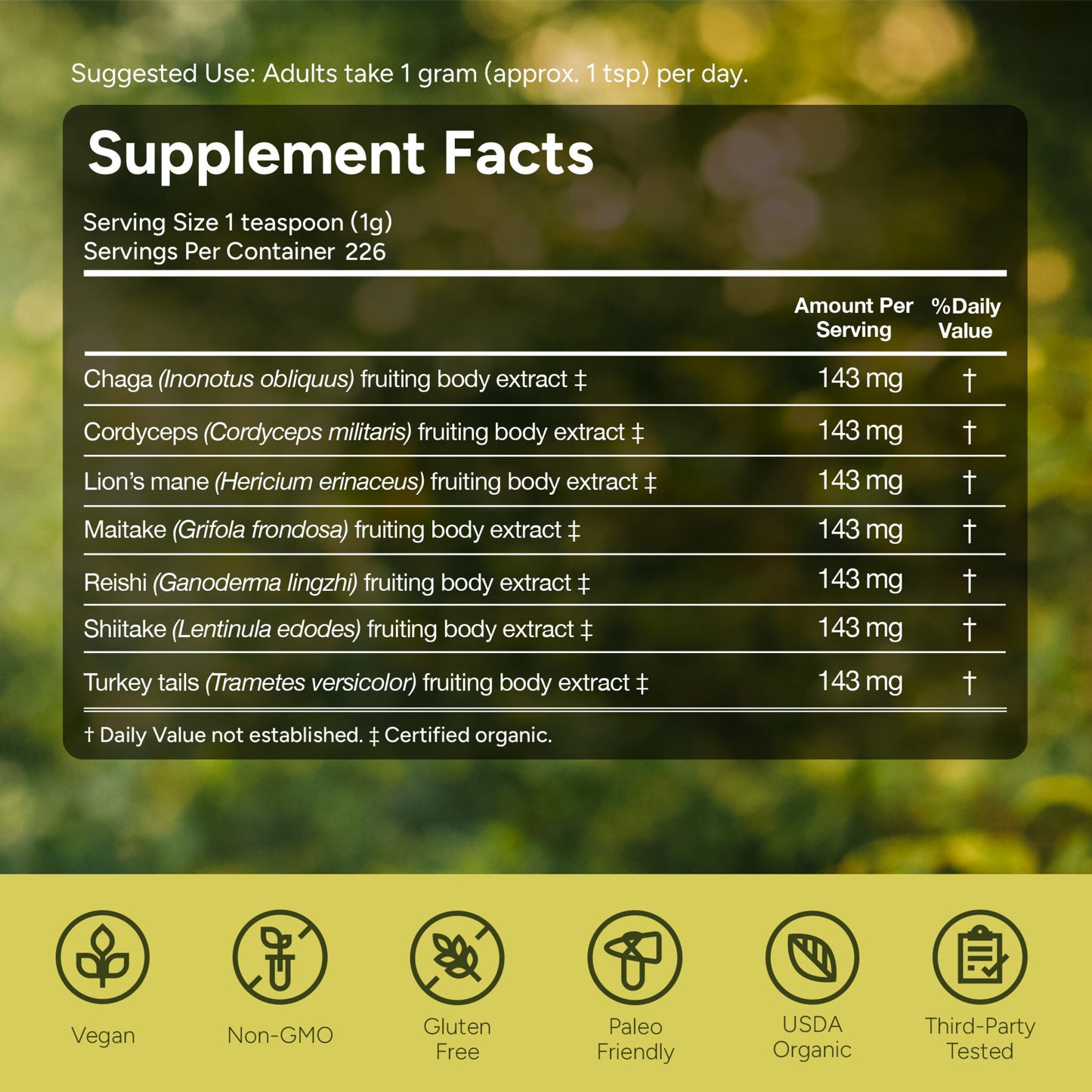
One level teaspoon is 1,000mg of seven functional mushrooms in equal parts, all 100% fruiting body and hot water extracted.

A mushroom extract powder is different from plain ground mushroom. Mushroom cell walls are made of chitin, which we don't digest well, so the fruiting bodies are extracted in hot water at 215°F to pull out the polysaccharides, especially beta-glucans, that most of the research is built on. The extract is then dried back into a fine powder. More on why fruiting body matters.
- Lion's Mane: studied for focus, memory, and cognitive function.
- Cordyceps (Cordyceps militaris): studied for energy and endurance.
- Reishi: studied for calm and sleep.
- Chaga: one of the most antioxidant-rich mushrooms.
- Turkey Tail, Shiitake, and Maitake: studied for immune support and gut health.
See the 7 mushrooms in Sacred 7 for the research on each one.
How Do You Fit Mushroom Powder Into What You Already Do?
Attach it to a habit you already have. "After I pour my coffee, I stir in a teaspoon" is easier to keep than "I'll take my mushrooms every day."
This is often called habit stacking: you anchor a new action to an existing one, so the old habit becomes the reminder. In a well-known study from University College London, people who repeated a simple daily health habit in the same context took a median of 66 days for it to feel automatic, with a range of 18 to 254 days (Lally et al., European Journal of Social Psychology, 2010). Missing a single day didn't derail them. The more your teaspoon rides on something you never skip, the faster it sticks.

| If you already... | Add the teaspoon here |
|---|---|
| Drink coffee every morning | Stir or froth it into the cup. See our Sacred 7 coffee recipe. |
| Make tea or matcha | Whisk it in with the matcha or after the tea steeps. |
| Blend a smoothie | Add it with the banana or nut butter. Try the green Sacred 7 smoothie. |
| Eat oatmeal or yogurt | Stir it in, or make Sacred 7 overnight oats the night before. |
| Cook dinner most nights | Stir it into soup, sauce, or dressing at the end. Try the mushroom powder vinaigrette. |
A few practical tips: keep the jar next to the coffee maker, not in a cabinet; use the same spoon every day; and if you share a kitchen, make it a two-person habit. Most people find that a mushroom supplement they can see is one they actually take.
Where Can You Get a Mushroom Powder That Fits Your Routine?
Sacred 7 Mushroom Extract Powder is available directly from Naturealm, with more than 11,000 reviews on Amazon.
One level teaspoon is 1,000mg of Lion's Mane, Cordyceps, Reishi, Chaga, Turkey Tail, Shiitake, and Maitake in equal parts: 100% fruiting body, hot water extracted at 215°F, and USDA Certified Organic, with no fillers, grain, or mycelium. The 8 oz jar holds about 226 servings. If you'd rather swallow it, three Sacred 7 Capsules equal one teaspoon.
Does Hot Coffee Damage Mushroom Powder?
No. Sacred 7 is extracted in water at 215°F, and freshly brewed coffee is usually a little cooler than that, around 195 to 205°F.
Because the extraction already happened at a higher temperature, stirring the powder into a hot drink won't undo it. For soups and sauces, stir it in after you take the pot off the heat, mainly so the flavor stays mellow. In cold drinks, blend or froth it so it disperses evenly.
What Does Mushroom Powder Taste Like?
Mild, earthy, and slightly bitter, closer to cocoa or a dark roast than to a mushroom you'd cook.
In coffee, most people barely notice it. It pairs well with cacao, cinnamon, vanilla, banana, nut butter, and a splash of milk. If it clumps, mix it with a spoonful of liquid into a paste first, or use a handheld frother; ours is the Naturealm Mushroom Coffee Frother, which also makes a smooth latte. For more ideas, see how to use mushroom powder and 18 Reishi mushroom recipes.
How Long Until You Notice a Difference?
Many people notice changes after 2 to 4 weeks of daily use, and the human studies on functional mushrooms ran 3 to 16 weeks.
Functional mushrooms aren't stimulants, so a single teaspoon won't feel like a shot of espresso. In one Lion's Mane trial, older adults who took it daily for 16 weeks improved on a cognitive test, and the gains faded after they stopped (Mori et al., Phytotherapy Research, 2009). That's the case for consistency, not a one-off. For timing by mushroom, see when to take mushroom supplements.
Is a Daily Teaspoon Right for Everyone?
Most people tolerate it well, but check with your provider first if you take certain medications.
Check with your provider first if you take blood thinners, blood pressure or diabetes medication, or immune-suppressing drugs, if you're pregnant or breastfeeding, or if you have surgery coming up. Reishi, Maitake, and Chaga are the mushrooms most often flagged. Mild stomach upset is the most common side effect, and taking it with food helps. Our guide on how to talk to your doctor about mushroom supplements covers what to ask.
Shop Sacred 7 Powder →Find your mushroom match →
References
- Lally P, van Jaarsveld CHM, Potts HWW, Wardle J. "How Are Habits Formed: Modelling Habit Formation in the Real World." European Journal of Social Psychology, 2010. doi:10.1002/ejsp.674
- Mori K, et al. "Improving Effects of the Mushroom Yamabushitake (Hericium erinaceus) on Mild Cognitive Impairment: A Double-Blind Placebo-Controlled Clinical Trial." Phytotherapy Research, 2009. doi:10.1002/ptr.2634
These statements have not been evaluated by the Food and Drug Administration. This product is not intended to diagnose, treat, cure, or prevent any disease.